.webp)

.svg)
Amazon DSP 2026: the complete guide for B2B brands
Amazon DSP in 2026: the most underused programmatic lever in the Amazon Ads stack
If you already run Sponsored Products and Sponsored Brands campaigns on Amazon, you have probably heard of Amazon DSP. You may know it as "the programmatic thing Amazon does", without a clear view of where it fits, what it actually adds, or when to switch it on. This guide answers those questions, with one goal: to give you a clear reading of Amazon DSP in 2026 and of its real return for your brand.
Update, 1 October 2026. On 29 September Amazon announced that Amazon DSP is now part of Amazon Ads Agent, its single ad platform. According to Amazon, existing campaigns keep running without disruption, with "the same inventory, the same audience signals, and the same reporting". This guide keeps the word DSP, because that is what people search for, and the prerequisites it describes do not change. The announcement in detail: Amazon Ads Agent, what changes.
Amazon Advertising has become the third largest advertising platform in the world behind Google and Meta (eMarketer 2024), with more than 56 billion dollars in advertising revenue in 2024. Within that stack, Amazon DSP is the programmatic layer: automated buying of advertising inventory on and off Amazon, targeting through advanced audiences, incrementality measurement through Amazon Marketing Cloud. It is also one of the layers European brands understand least.
1. What Amazon DSP is, and what it is not
Amazon DSP (Demand-Side Platform) is Amazon Ads' programmatic buying solution, now part of Amazon Ads Agent. It lets brands buy display, video and audio inventory across Amazon properties (homepage, product pages, apps) and beyond: Prime Video, Twitch, Fire TV and thousands of third-party sites and apps, including those of Amazon Publisher Services.
Amazon DSP versus Sponsored Display
Until now the line was clear:
Sponsored Display. Self-service inside the ads console, mostly CPC, with simple audiences (Amazon shoppers, basic lookalike). Used for straightforward retargeting of Amazon product pages.
Amazon DSP. A separate tool, full-stack programmatic. Mostly CPM. Advanced audiences (in-market, lifestyle, lookalike, custom through AMC). Amazon inventory plus off-Amazon inventory. Well suited to awareness, consideration, cross-domain retargeting and win-back.
Sponsored Display "is now known as display ads", and existing campaigns keep running. The difference with DSP has not changed: display ads are run from the Amazon Ads console, mostly for retargeting, while Amazon DSP gives access to the full inventory, advanced audiences and fine-grained settings (targeting, deals, supply sources, frequency caps, bidding strategy).
Amazon DSP versus Google DV360 or Meta Ads
DSP shares its programmatic philosophy with DV360 (Google), Meta Ads and The Trade Desk, but with one differentiating advantage: access to Amazon's first-party purchase signals. Where Meta targets on declared interests and Google targets on search intent, Amazon DSP targets on actual buying behaviour, who bought what, who viewed which product, who converted after which journey. For e-commerce, that data has no equivalent.
2. Who Amazon DSP is really for
DSP is not for everyone. Here are the honest eligibility criteria, based on what we see on the accounts SkyVision manages.
The other side of this question deserves its own article: we have set out the four conditions to meet and the three cases where waiting is the better call in our piece on the minimum budget for Amazon DSP.
ICP profile: B2B e-commerce brand with a catalogue of more than 10 SKUs
Existing Amazon Ads spend of at least 5,000 euros a month, otherwise DSP lacks the audience mass to optimise. A catalogue of at least 10 SKUs on a European or international Amazon marketplace, otherwise the retargeting budget is spread too thin. An active Brand Registry, which is a prerequisite for the creative formats. A brand with an existing Brand Store, because well-run DSP sends traffic to a Brand Store rather than to isolated product pages.
When DSP genuinely helps
Brand awareness: a new brand or a new range to introduce to a precise segment. Consideration: prospects who saw your product page and did not buy, to be re-engaged with dedicated creative. Retention: existing customers to upsell or cross-sell. Win-back: churned customers to reactivate. Off Amazon: reaching prospects on Twitch, Prime Video, Fire TV and partner sites.
When DSP is not the priority
An account whose Sponsored Products ACOS is not yet under control: stabilise SP before scaling DSP. A total monthly Amazon Ads budget below 5,000 euros, since DSP needs a threshold to function. A catalogue of only one or two SKUs, where the signal is too weak for DSP audiences. A brand with no Brand Store and no A+ Content, where DSP sends traffic to thin pages and the return collapses.
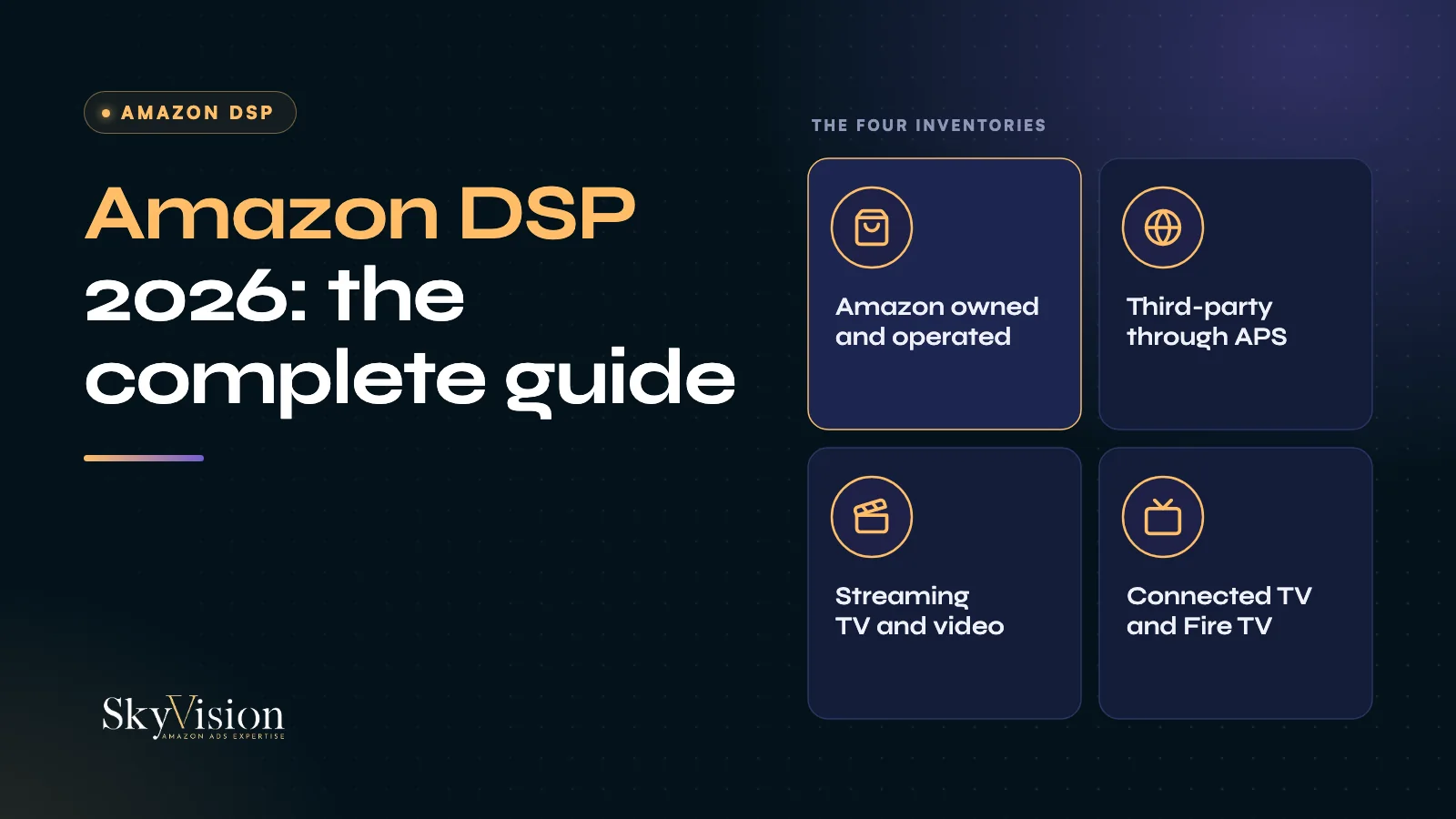
3. The four Amazon DSP inventories in 2026
Amazon DSP gives access to four broad categories of advertising inventory. Understanding the logic of each one is what shapes the strategy.
Amazon owned and operated (O&O)
Amazon's own properties: the Amazon homepage with its hero banner placements, search results, product pages, the basket page, the Amazon mobile app. This is the most qualified inventory, because users are in active buying mode. Ideal for retargeting and conversion.
Third-party through Amazon Publisher Services (APS)
Websites and apps partnered with Amazon. Premium inventory, wider than O&O but less qualified, since users are simply browsing. Ideal for awareness reach and top of funnel.
Streaming TV and video: Prime Video, Twitch, Fire TV
Amazon's video inventory. Prime Video has been serving advertising on the standard subscription since 2024, with an ad-free tier available at extra cost. Twitch concentrates a young, engaged gaming audience. Sponsored TV is part of this video inventory.
Connected TV and Fire TV
Smart TVs and Fire TV devices. CTV inventory is growing fast. It is particularly relevant for consumer brands with a scaling budget that want to reproduce the logic of linear television with data-driven targeting.
The inventory mix is calibrated against your objective: mostly O&O for conversion retargeting, a mix of O&O and APS for consideration, a mix of video and APS for brand awareness.
4. Amazon DSP audiences: where the real value sits
If DSP has one strong advantage over DV360 or Meta Ads, it is audience quality. Amazon audiences are built on first-party purchase signals: who bought, who viewed, who converted, who abandoned a basket.
In-market audiences
Users who have shown active buying interest in a given product category through recent searches, product browsing or basket additions without conversion. Large volume, medium qualification, ideal for consideration.
Lifestyle audiences
Users whose consumption profile is consistent with your brand, for example endurance sport buyers, new parents or cooking enthusiasts. Very large volume, low qualification, ideal for top-of-funnel brand awareness.
Lookalike audiences
Audiences modelled from your own buyers. You supply your Amazon buyer list through your Brand Account and Amazon generates a scalable lookalike. Adjustable volume, high qualification, ideal for new-to-brand acquisition.
Custom audiences through Amazon Marketing Cloud (AMC)
The most powerful lever. You combine Amazon's first-party signals with your CRM or with custom business rules: cross-marketplace buyers, viewers who watched 75 per cent of a 30-second video on Prime Video, basket abandoners above 50 euros. See our Amazon Marketing Cloud offer.
5. Amazon DSP use cases by funnel stage
Here is how serious brands orchestrate DSP across the buying funnel. These five cases cover the majority of profitable DSP activations.
New-to-brand awareness
Targeting: lifestyle audience plus broad category in-market. Inventory: APS plus Streaming TV. Format: 15 to 30 second video, or rich media display. Key metric: New-to-Brand Rate, the share of DSP conversions coming from customers who had never bought from you in the past 12 months. For pure awareness, you aim for a high new-to-brand share, typically more than half of conversions.
Product consideration
Targeting: viewers of your product pages who did not buy. Inventory: O&O plus APS. Format: display carrying product messaging or a price drop. Metrics: view-through conversion rate, click-through rate, view-through return on ad spend.
Conversion retargeting
Targeting: basket abandoners or recent product page viewers, within seven days. Inventory: mostly O&O. Format: dynamic product-based display. Metric: click-through return on ad spend. This is the best converting lever in the DSP funnel.
Cross-sell and upsell
Targeting: recent buyers of a complementary product, for instance targeting your sleeping bag at people who bought your tent. Inventory: O&O plus Amazon emails as an advanced option. Format: display with a product carousel. Metrics: average basket lift, cross-sell ratio.
Win-back
Targeting: buyers who have not ordered in 6 to 12 months. Inventory: O&O plus APS. Format: display with a specific offer, such as a renewal discount or a new range. Metrics: reactivation rate, customer lifetime value before and after.
6. Setting up an Amazon DSP campaign, step by step
Here is the standard workflow to launch a first DSP campaign. Expect two to four weeks of setup depending on complexity.
Step 1. Prerequisite audit (3 to 5 days)
Check Brand Registry is active. Audit the Brand Store and A+ Content, and strengthen them if thin. Inventory the audiences you already have, in your Amazon Brand Account and in any exportable CRM. Define your target metrics: return on ad spend, new-to-brand share, frequency cap.
Step 2. Audience strategy (2 to 3 days)
Map use cases against the funnel. Choose in-market, lifestyle, lookalike or custom audiences by objective. Set the frequency cap, three to seven impressions per user per week, to be calibrated. Set up Amazon Marketing Cloud if custom audiences are needed.
Step 3. Asset production (3 to 5 days)
Display banners in Amazon DSP formats: 300x250, 728x90, 970x250 and mobile responsive. Video of 15 to 30 seconds for Streaming TV and Twitch. A/B testable variants, at least two per segment. Compliance with brand guidelines and with Amazon ad policies.
Step 4. Campaign setup (1 to 2 days)
Create the campaign in the Amazon DSP console. Allocate budget by audience and by inventory. Set the bidding strategy, optimised CPM with a maximum CPM cap. Set pacing, daily or monthly. Launch in test mode for 7 to 14 days before scaling.
Step 5. Continuous optimisation (ongoing)
Daily review for the first 14 days. Pause underperforming audiences. Scale performing audiences progressively. Test creative, rotating at least every 14 to 21 days. Monthly AMC reporting to measure incrementality.
7. The Amazon DSP metrics that actually matter
The classic trap is to read DSP return on ad spend in isolation. Without context it is misleading. Here are the metrics that count.
Two extensions of this, with figures from a live account: the metric that belongs to each funnel stage, and the method for measuring brand halo, which accounted for 51.2 per cent of the revenue generated in our test.
Click-through and view-through return on ad spend
Click-through return is measured on conversions that follow a click on the advertisement. View-through return is measured on conversions that follow an impression without a click. Both count. A user can see your Prime Video advertisement, not click, and buy the next day through an Amazon search. That is incrementality, and only DSP captures it.
New-to-Brand Rate
The share of conversions generated by buyers who had never bought your brand on Amazon in the past 12 months. A critical metric for awareness campaigns. The higher it is, the more genuinely new business you are acquiring. On retargeting it falls mechanically, which is normal.
Actual frequency cap
How many times the same user is exposed to your advertisement per week. Beyond a certain frequency the marginal return collapses and brand irritation rises. Tracking actual frequency against target is essential.
View rate and completion rate (video)
For video campaigns on Prime Video, Twitch and CTV: view rate, the share of videos watched to 50 per cent, and completion rate, the share watched to the end. Both measure engagement independently of clicks or sales.
Total return on ad spend (DSP plus Sponsored Ads)
The metric that settles the question. A total advertising cost of sales that includes DSP, Sponsored Products, Sponsored Brands and organic revenue answers the only question that matters: is my overall Amazon Ads investment generating profitable revenue? It is measurable only through Amazon Marketing Cloud, or by aggregating the sources by hand.
8. Common mistakes, and how to avoid them
Across the DSP accounts we manage, these are the seven most frequent activation mistakes.
Launching DSP before Sponsored Products is stable
DSP sends prospects to your product pages. If those pages do not convert because of a weak title, missing A+ Content, uncompetitive pricing or stockouts, you are paying for traffic that goes nowhere. Stabilise SP first, scale DSP after. The four signals that tell you your account has hit its advertising ceiling are a good place to start.
Under-sizing the initial budget
DSP needs a budget threshold for the algorithm to learn. Below 3,000 to 5,000 euros a month per campaign the algorithm lacks signal and optimisation becomes erratic. Concentrating the budget on one or two audiences and a single use case beats spreading it thin.
Confusing awareness with retargeting
Running an awareness campaign against hot in-market audiences, which is retargeting in disguise, then being surprised by the low return. Awareness aims at new-to-brand, retargeting aims at conversion. Different metrics, different audiences.
A badly calibrated frequency cap
Without a cap, the same user is exposed 30 times in a week. The result is irritation, falling brand sentiment and negative marginal return. Recommended cap: five to seven per week on display, three to five on video.
Ignoring incrementality
Reading DSP return in isolation and concluding it is profitable. Without Amazon Marketing Cloud there is no way to know whether DSP genuinely added revenue or simply cannibalised Sponsored Products traffic. AMC is the only tool that answers.
Never rotating creative
The same two creatives for six months. Creative fatigue sets in within two to three weeks depending on exposure frequency. Refresh at least every 21 days, ideally every 14 at high frequency.
No Brand Store audit beforehand
DSP sends traffic to your Brand Store or to product pages. If the Brand Store is outdated, poorly structured or unfriendly on mobile, you are burning budget. Audit the Brand Store and A+ Content before launching DSP.
9. Self-service versus agency-managed: when to move to an agency
Amazon DSP exists in two operating models.
Self-service DSP
You run campaigns yourself in the Amazon DSP console. Amazon keeps both access models, self-service and managed service. The entry threshold is not a single figure: it depends on the access model, the country and the account history. You own the setup, the audiences, the creative and the optimisation. Suited to brands with a dedicated senior DSP team and significant monthly DSP spend.
Agency-managed DSP
An Amazon Ads verified partner agency runs your DSP through its agency account. The advantages: a much lower entry threshold, from a few thousand euros a month, pooled expertise, access to Amazon product betas, AMC incrementality measurement included, and optimisation by senior consultants. Suited to most brands with DSP spend between 3,000 and 50,000 euros a month.
When you move from agency back to self-service
Concrete criteria: high DSP spend sustained over several consecutive months, an in-house team with a senior DSP lead plus a junior plus a data analyst, a mature AMC process, and the capacity to manage creative internally. Below that, agency-managed remains more profitable. See our managed Amazon DSP offer.
A concrete case: Polar, DSP inside a complete stack
On the Polar account (sports technology), DSP is part of a complete stack of Sponsored Products, Sponsored Brands, Sponsored Display and DSP that contributed to moving return on ad spend from 6.4 to 10.8 and to 203 per cent growth in Amazon revenue over 12 months. DSP did not do all of it, but without the programmatic layer (cross-domain retargeting, Prime Video awareness, AMC custom audiences) growth would have plateaued.
Results from a real client case. Past performance does not guarantee future results. Outcomes vary by catalogue, budget, category and competition.
September 2026 update: what changed, and what did not
If Amazon DSP still means "a banner on a news site" in your head, the picture is two years out of date. Two things have changed since. A third has not moved an inch, and that is the one that trips people up.
First change: where your advertisements appear
Amazon has absorbed inventory that used to sit elsewhere. Spotify has been available programmatically through Amazon since 1 October 2025, France included, and Netflix was announced for France from the fourth quarter of 2025. Streaming audio widened, podcasts came in.
You no longer pick a format, you pick an environment. Display across the web and apps. Video, with connected television and streaming, which amounts to running television advertising without a television budget. Audio, on music streaming and podcasts, which works mainly alongside video rather than on its own.
Second change: the controls
Two automated formats arrived. Brand+ looks for audiences likely to act after seeing the ad: visit a Store, add to cart, buy. Performance+ targets consideration and conversion, reaching shoppers who are actively in the market.
Previously you had to build audiences, structure line items and arbitrate bids. The technical barrier has dropped sharply. But these tools absorb volume at the top and at the bottom of the journey. The middle (fine targeting, exclusions, arbitrating between audiences) stays manual. Automation at the top, automation at the bottom, humans in the middle.
The question we get most about these two formats: does this replace a manager? No. It replaces execution. It does not decide which funnel stage to saturate first, when to cut, or how to read a counter-intuitive result. That is where profitability is won, and it has stayed human. Our article on the metric that belongs to each funnel stage sets out that reading.
What has not moved
The learning phase. Thirty to forty-five days before the numbers mean anything. No automation has shortened it. People judge at fifteen days, panic, and cut at the worst possible moment: just before it starts working.
DSP does not repair anything either. Product pages that do not convert, an absence of reviews, margins that are too tight: it will only accelerate the problem. And it does not replace your Sponsored Ads. If your search campaigns are not saturated, you are leaving easy money on the table. The conditions to meet are set out in our article on the minimum budget for Amazon DSP.
Inventory has exploded, the controls have been automated, the prerequisites have not moved.
Frequently asked questions about Amazon DSP
What is the minimum budget to start with Amazon DSP?
There is no single figure. For managed service, Amazon says budget minimums apply, without publishing the amount; in self-service, through a partner that holds the seat, the entry amount is negotiable. The threshold that matters is the one that lets you saturate at least one stage of the funnel: it depends on your catalogue, your margin and how mature your search campaigns are. More in our article on the Amazon DSP minimum budget.
How long before the first DSP results?
Learning phase: 30 to 45 days while the algorithm learns which audiences perform. First meaningful metrics, such as new-to-brand share and view-through return, come at the end of that phase. Structural results and profitable scaling: three to six months. Nobody should be promising immediate DSP results. That is a warning sign.
Is Amazon DSP profitable for small brands?
Not usually, outside specific cases. Brands with low annual Amazon revenue will struggle to absorb the opportunity cost of DSP against a more profitable Sponsored Products investment. DSP becomes relevant once you have established Amazon Ads spend and a mature catalogue.
Do you need Amazon Marketing Cloud to run DSP?
Not to launch a basic DSP campaign, but yes to measure real incrementality: that is, to know whether DSP genuinely added revenue or cannibalised Sponsored Products. Partner agencies activate AMC as standard for their DSP clients. See our Amazon Marketing Cloud offer.
How does Amazon DSP compare with Sponsored Display?
Sponsored Display, now known as display ads, remains the simple format: it runs from the Amazon Ads console and is mostly used for retargeting. Amazon DSP is the full tool: off-Amazon inventory (Prime Video, Twitch, Fire TV, third-party sites and apps), advanced audiences, deals, frequency. Display ads serve quick retargeting wins; DSP serves a complete programmatic strategy.
The last word
In 2026 Amazon DSP is the most underused programmatic lever in the Amazon Ads stack. For brands with a solid catalogue, a mature Brand Store and an Amazon Ads budget above 5,000 euros a month, DSP unlocks three things Sponsored Products alone cannot: measurable new-to-brand awareness, cross-domain retargeting including off Amazon, and access to premium video formats on Prime Video, Twitch and streaming TV.
The critical part: do not launch DSP before Sponsored Products is stable, do not under-size the initial budget, and always measure incrementality through Amazon Marketing Cloud. Without those three, DSP becomes an opaque cost line rather than a measurable growth lever.
SkyVision is an Amazon Ads verified partner, having managed more than 6 million euros of Amazon ad budget since 2023, including a significant DSP share, for French and international B2B brands. To assess whether DSP fits your catalogue, request a free audit or read our managed Amazon DSP offer.


