.webp)

.svg)
How to measure the brand halo of an Amazon DSP campaign
How to measure the brand halo of an Amazon DSP campaign
Pull, over the same period and the same campaigns, the sales attributed to the products you actually advertised, then the sales attributed to your brand as a whole. The gap between the two is your brand halo. Amazon defines brand halo as conversions on products from the same brand as the ones featured in the ad, as set out in its attribution documentation.
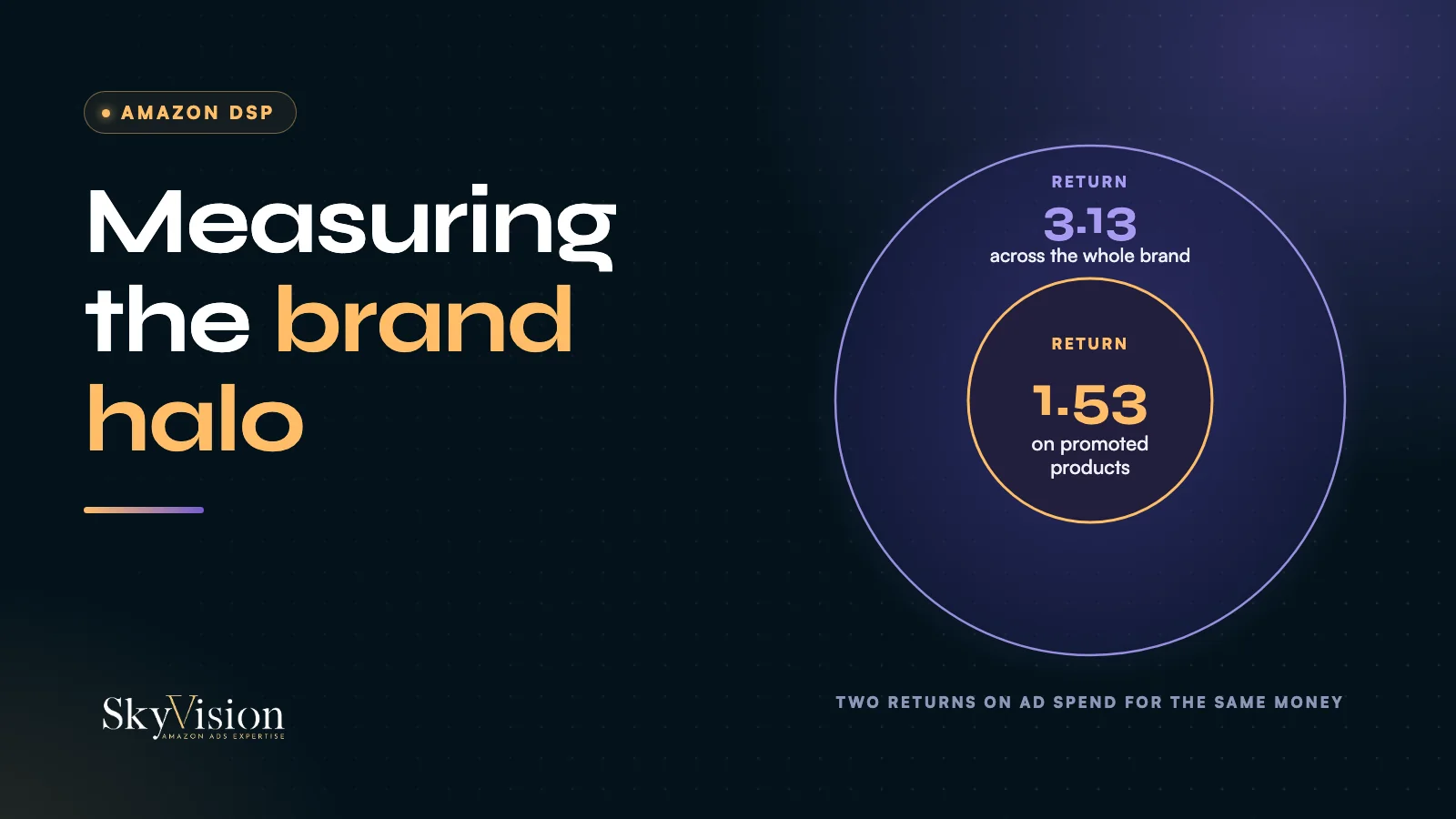
Two returns on ad spend for the same money
This summer, on a beauty and fragrance account, we spent €12,493 on Amazon DSP over two months.
The products we actually advertised generated €19,104 in sales. Against the spend, that is a return of 1.53.
The brand as a whole generated €39,134 from the same campaigns over the same period. That is a return of 3.13.
Both numbers are true. One makes you double the budget. The other makes you switch the campaign off.
Between them sits €20,030. Put differently, 51.2% of the revenue generated by those campaigns came from products we never spent a penny promoting.
Where does Amazon brand halo actually come from?
We pushed the brand's best seller. People saw it, arrived on Amazon, and a share of them left with something else. A different format, a bundle, the variant sitting next to it.
The well-known product was not the sale. It was the door.
It has reviews, it reassures, it costs less to get a click on. It brings people in. The rest of the range collects.
Two things change once you understand that.
On strategy: you do not advertise a catalogue, you advertise one product in order to sell a catalogue. Choosing which product to promote becomes an acquisition decision, not a merchandising one.
On measurement: if you judge campaigns purely on the sales of promoted products, you are looking at half the result. And you will switch off a profitable campaign convinced you made the right call.
How do you measure brand halo on your own account?
The exercise takes about ten minutes. The vocabulary matters, because it is the vocabulary of the Amazon reports.
1. Fix a period and a set of campaigns
Choose a window long enough to clear the attribution period, and select only the campaigns whose effect you want to measure. Mixing DSP and search campaigns distorts the reading because their attribution windows differ.
2. Pull promoted product sales
These are the sales attributed to the ASINs that actually appeared in your ads. It is the figure most reporting shows by default, and the one that produces the lower return.
3. Pull brand-wide sales
These are the sales attributed to all products from the same brand, promoted or not. On DSP, the brand new-to-brand purchase statistics and the attribution reports let you isolate that share.
4. Check the attribution window you are comparing
This is where most calculations go wrong. Attribution windows are not identical across channels, and sometimes not even across reports inside DSP. Compare a fourteen-day line to a thirty-day line and part of the gap you read as halo will be a measurement artefact. Fix the same window on both sides before subtracting, and write down which one you used so next month's calculation is comparable.
5. Take the difference and express it as a share
The gap in currency is your halo. Expressed as a percentage of total generated revenue, it becomes comparable across periods. Track the percentage rather than the absolute figure, because it does not move with budget size.
When does brand halo fail to trigger?
Halo does not trigger by itself, and it does not apply to everyone.
Without range depth there is no rebound. With a single product there is nothing to rebound onto and half the channel's value disappears. It is one of the conditions we check before opening DSP, as covered in our article on Amazon DSP minimum budget.
The entry product and the rest of the range also have to serve the same need. On this account the range was coherent around one use case. Promote a product unrelated to the rest of your catalogue and you get no rebound, just an isolated sale.
What halo changes about which product you promote
Once you have the number, the choice of entry product stops being obvious.
The instinct is to advertise what you most want to sell, usually the highest-margin line. If halo is working on your account, that instinct is wrong. You are better off advertising whatever costs least to get a click on and reassures fastest, then letting the rest of the range collect. That is usually the best seller, because reviews and ranking do the reassurance for you.
The test is straightforward: run the halo calculation separately for each product you promote. Some will show almost no halo, meaning they sell themselves and nothing else. Others will show a large one. Budget belongs on the second group, and that is not always where it currently sits.
What this number does not tell you
Brand halo measures an attribution correlation, not pure causality. Some of those sales might have happened without the campaign.
That is true, and it is exactly why you should not naively add up the sales attributed to each channel. On the account cited, adding DSP and Sponsored Ads attributed sales comes to 65% of total revenue. Part of that is double counted, since the same person can see a DSP banner and then click a Sponsored Product. Which is why we always judge on total revenue and total advertising cost of sales, never on the sum of the returns.
Frequently asked questions
What is the difference between promoted product sales and brand sales?
The first counts only the ASINs that were in the ad. The second also counts other products from the same brand bought after exposure. The second line is always equal to or higher than the first.
Does brand halo exist on Sponsored Brands too?
Yes. Sponsored Brands attribution reports also separate promoted product sales from brand sales. The mechanic is the same; the scale depends mostly on how deep your catalogue is.
Is a 51% halo normal?
It is the figure observed on one account, with a coherent range and an identified best seller acting as the entry point. It is not a benchmark and it is not a target. On a narrow catalogue the value will be far lower, and that is expected.
Should you promote the best seller or the high-margin products?
Both arguments hold, but they play different roles. The best seller costs less to get clicks on and brings people in. High-margin products collect better. If halo is working, promoting the first to sell the second is often the more profitable trade. You have to measure it before deciding.
Is brand halo the same as the Amazon halo effect from off-platform ads?
No, and the terms get mixed up constantly. Brand halo is an Amazon attribution metric covering brand-wide conversions from an Amazon campaign. The broader halo effect people describe usually refers to Amazon sales driven by advertising run outside Amazon entirely. Different measurement, different reports.
We will measure your halo with you
If you want to know how much revenue your campaigns generate outside the products you are paying for, we run the calculation on your account. It is often the number that changes a budget decision. Our comparison of cost per new customer by channel covers the other half of the picture. We run this calculation on every account we audit, as an Amazon Ads agency and verified partner. Ask us for an audit, free and with no strings attached.
On where the figures come from: one account, beauty and fragrance, July and August 2026, anonymised with the client's consent. Two months, including 30 to 45 days of learning. A 51% halo on that account tells you nothing about yours, and we are not offering it as a benchmark. It is a method we are documenting, not a norm. Past performance does not guarantee future performance.


