


Amazon DSP minimum budget: the entry threshold is not the effectiveness threshold
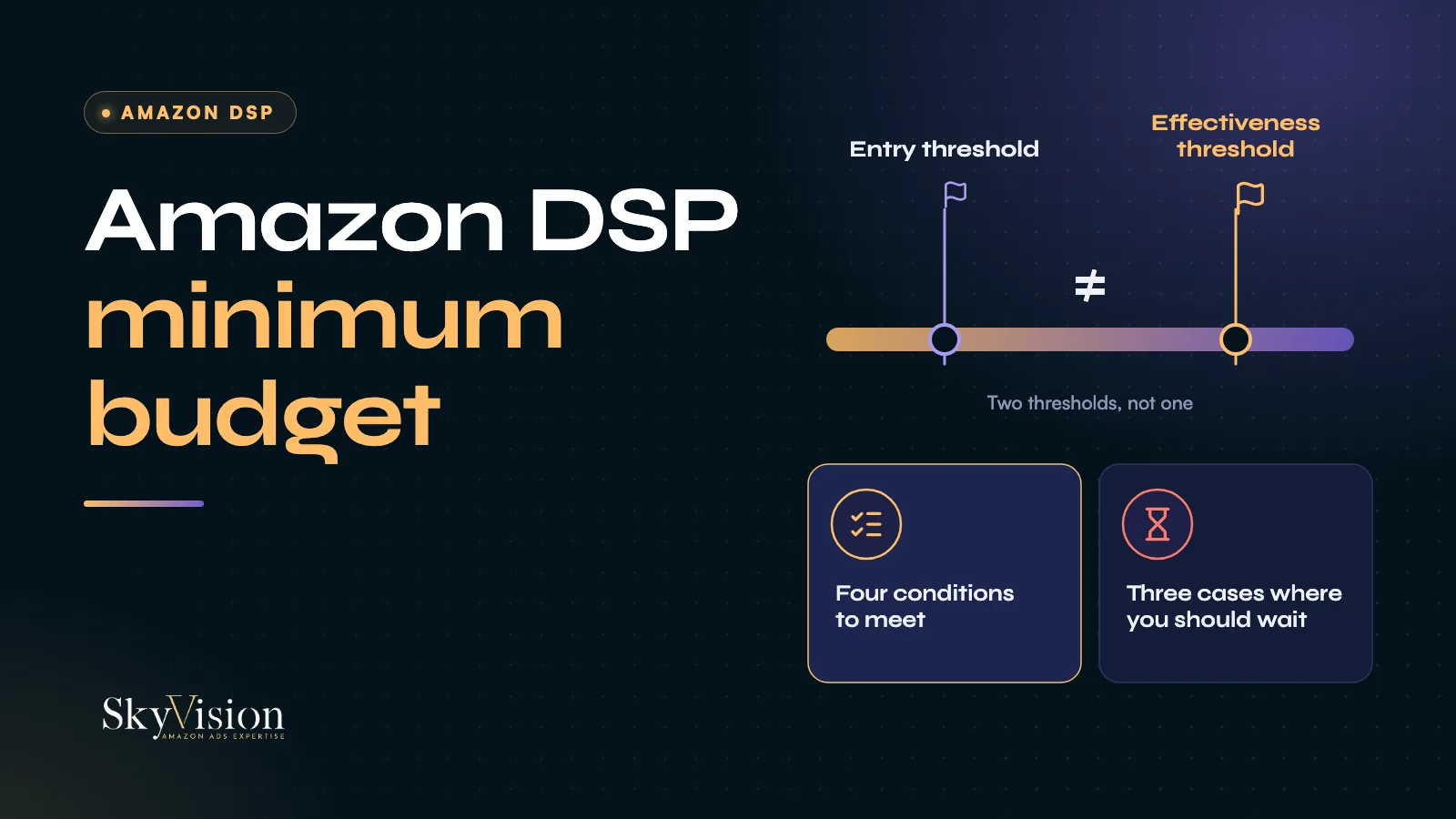
Amazon DSP minimum budget: there are two thresholds, not one
When we wrote this article, the official Amazon DSP page showed a $50,000 minimum for managed service, varying by country. Re-read on 1 October 2026, it shows no figure at all: DSP is now part of Amazon Ads Agent, and Amazon no longer publishes a figure. Meanwhile the agency pages covering the topic quote anything from $1,000 to $50,000. Nobody is really lying. They are answering two different questions without saying so.
Update, 1 October 2026. On 29 September Amazon announced that Amazon DSP is now part of Amazon Ads Agent. The two thresholds described here stay the same; only the reference to Amazon's published figure has changed. The announcement in detail: Amazon Ads Agent, what changes.
Update, November 2026. We added the video by Quentin, co-founder of SKYVISION, on the entry threshold and his advice for a first test on a tight budget.
The threshold to open an account and the threshold to make the channel work are not the same number. The first is lower and more negotiable than most articles suggest. The second has nothing to do with a rate card. It depends on your catalogue, your margin and how mature your search campaigns already are.
Quentin answers on video (5 minutes, in French with English subtitles) the line he hears most often when he talks about DSP with potential clients: "DSP is only for big budgets". SKYVISION is an agency specialised in Amazon advertising, so our view is not neutral.
Why do published Amazon DSP minimum budget figures contradict each other?
There are two ways into Amazon DSP, self-service and managed service. With managed service, an Amazon Ads team runs the campaign, and Amazon's pricing transparency guide simply says "Budget minimums apply". The figure itself is no longer on its pages: on 25 September 2026 the Amazon DSP page still showed $50,000, varying by country. Self-service, whether you open the account yourself or through a partner, works differently, and the entry figure is different too.
Most articles never say which route they are describing. That is the whole reason one page tells you €10,000 and the next tells you $50,000. Both describe something real, just not the same thing.
What matters to you sits elsewhere. A budget that gets you through the door does not guarantee you will reach the point where the channel produces anything. Below a certain volume, three things happen at once. You never reach a useful frequency against your audience. Campaign learning drags because there is not enough data. And you do not generate enough events to do anything serious with Amazon Marketing Cloud.
So the question is not whether you have the budget. It is whether your budget lets you saturate at least one stage of the funnel.
The entry threshold: a starter test against a commitment
The first threshold is the contractual one. Quentin describes it from what we negotiate with Amazon: the pattern that keeps coming back is a starter test, accepted if the advertiser commits to spend more over the following quarter. He gives the order of magnitude of the amounts in the video. The figure is negotiable, and it mostly depends on your account: your spending history on Amazon and what you can invest. Amazon decides case by case, and not everyone gets a DSP account.
Another common belief: a brand that does not sell physical products on Amazon historically had to go through a large agency. Quentin explains that this is no longer true: if someone tells you they are the only ones who can open a DSP account, that is wrong, and you can even open it yourself, without an agency.
Quentin also mentions a client he recently brought onto DSP with a one-month test on a very narrow scope. The results were good, and the client invested much more afterwards. This case does not generalise: the second threshold is, in Quentin's view, the most important.
What conditions should you meet before opening Amazon DSP?
We opened a DSP seat this summer on a beauty and fragrance account. It met four conditions, and that explains the outcome far better than the amount invested.
Sponsored Ads that are already mature and profitable
Search campaigns that were already mature were running before we opened DSP. This is the most important condition and the one most often skipped. If your search campaigns are not saturated, there is cheaper money to collect there first.
A catalogue with real depth
This is what makes brand halo possible. You promote a known product, shoppers land on Amazon, and a share of them leave with something else from your range. With a single SKU that mechanic does not exist and you lose half the value of the channel.
Margin that can absorb a channel that does not pay back on the first order
On that account, advertising accounted for 22.5% of revenue across all channels. That is sustainable in this category. On a 20% margin it would not be. The total advertising cost of sales you can carry is a line in your P&L, not an industry best practice.
Enough volume for the algorithm to learn
Below a certain number of conversions, learning never completes. Quentin gives a rough figure: making decisions on 30, 40 or 50 sales is not necessarily very reliable. You pay for the learning phase without ever reaching the phase where it earns its keep. It looks like channel failure. It is a volume problem.
Three cases where you should wait
The advice we give most often in meetings is: not yet. Three situations where opening DSP burns budget while the real lever sits untouched next to it.
Your margin cannot carry upper funnel
DSP reaches people who do not know you yet. That costs structurally more than a click on your own brand name, and it does not necessarily pay back on the first order. If your margin leaves no room for that lag, the channel will put you under pressure before it produces anything.
You have a single product
Without range depth there is nothing to rebound onto, and not enough material to build audiences from. You fund visibility that lands on one SKU.
Your Sponsored Ads are not saturated
The most common case, and the most expensive. Before paying to create demand, collect the demand that already exists. If you are unsure whether you have reached the end of your search campaigns, the four signals of an advertising ceiling answer that in twenty minutes.
What can you actually run on a tight Amazon DSP budget?
One setup holds up with limited spend: retargeting only, on a narrow catalogue. It is the smallest and warmest audience you have. It tolerates a reduced budget well because everything is concentrated on few people. Before committing a larger budget, the market test with Amazon DSP shows how to decide on data.
Quentin adds two rules. Only push the ASIN that already works: a product that sells poorly on Amazon will not sell better thanks to DSP. And keep the point of retargeting in mind: reaching people outside Amazon who may already have seen your product, so they come back and buy. Quentin also notes that not everything is within reach of a small budget: on Netflix, for example, the cost per thousand impressions is very high.
What does not work on a tight budget is broad upper funnel, and running all three funnel stages at once. You end up with three underfed campaigns instead of one that actually runs. This is the most common mistake among brands starting the channel, usually because someone sold them a complete setup.
What budget will never decide for you
One last point, because it saves a lot of disappointment. DSP does not fix anything. Listings that do not convert, no reviews, margin stretched too thin: the channel will only make the problem arrive faster. You will simply pay more quickly to find out it does not work.
It also does not replace your Sponsored Ads. If your search campaigns still have affordable volume left, DSP is not your priority, whatever your budget looks like.
Frequently asked questions
Can you run Amazon DSP on a small budget?
Yes, provided you target one funnel stage only. Retargeting on a narrow catalogue works with modest spend. Broad upper funnel does not. And three campaigns opened at once on a budget sized for one will not produce anything you can read.
Does DSP replace Sponsored Products?
No. Search campaigns harvest demand that already exists. DSP goes after people who are not searching yet. They do not cancel each other out, they sit at different points in the journey. Our review of what's new in Amazon DSP also comes back to this question.
How long before you can judge a DSP campaign?
The learning phase runs roughly 30 to 45 days. No amount of automation has shortened it. Judging at two weeks and switching off means stopping right before the channel starts working.
Do you need an agency to access DSP?
Not necessarily. Self-service exists, and nobody holds an exclusive right to open a DSP account, as Quentin points out in the video. The real question is different. Recent automation (Brand+ and Performance+) covers the top and the bottom of the journey; the middle is still manual, and that is where profitability is decided. Our Amazon DSP service covers that part.
We will also tell you when it is not the right time
We look at three things: how mature your Sponsored Ads are, your total advertising cost of sales, and how deep your catalogue goes. If all four conditions listed in this article are met, the question stops being whether you should run DSP and becomes why you are not running it yet. If they are not, we tell you what to fix first. For a first answer, the diagnostic Is Amazon DSP right for your brand? is yours to try: 5 questions and a clear verdict. We are an Amazon Ads agency and an Amazon Ads verified partner. Request your complimentary Amazon Ads audit.
A note on the figures above. They come from one account, beauty and fragrance, July to August 2026, anonymised and published with the client's consent. Eight weeks of delivery including a 30 to 45 day learning phase, so nothing here is stabilised. One account is not a study. Past performance does not predict future performance, and what you get depends on your catalogue, your budget, your category and who you are bidding against.
Further reading: Amazon DSP without selling on Amazon, what the platform changes for your brand.


