.webp)

.svg)
Cost per new customer on Amazon: DSP, Sponsored Brands, Sponsored Display
Cost per new customer on Amazon: DSP, Sponsored Brands, Sponsored Display
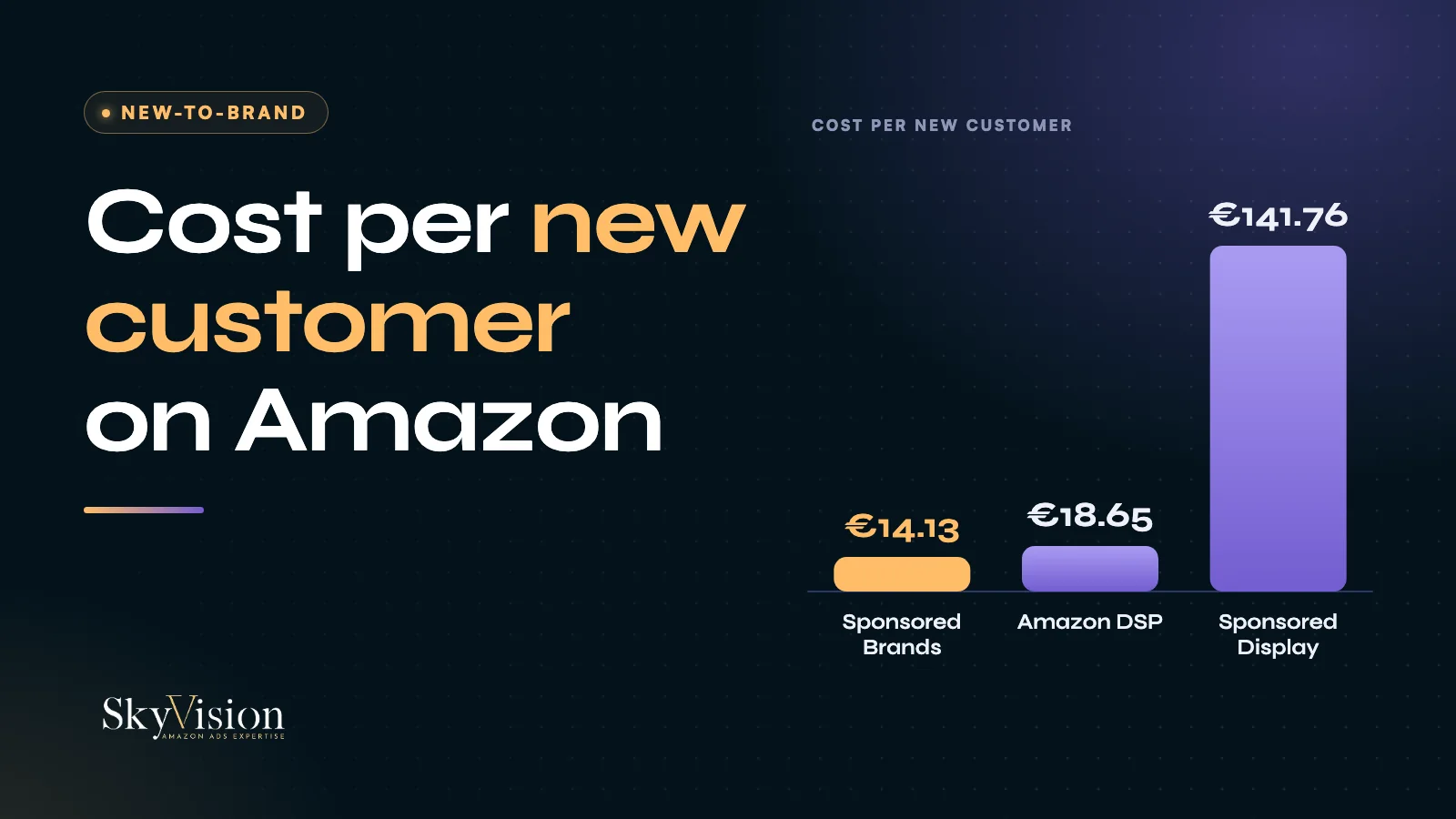
On a beauty and fragrance account, two months of Amazon DSP recruited 670 new customers, 53.2% of all purchases generated by the channel. Cost to acquire one: €18.65. Average basket of a new customer: €31.26. The customer returns more than they cost on the first order, before counting any repeat purchase.
That is the opening figure. What follows is more useful, because it includes what cannot be compared, and one result that does not flatter us.
Can you compare new-to-brand across every Amazon channel?
Amazon does not report the new-to-brand metric on Sponsored Products. It exists on Sponsored Brands, Sponsored Display (which Amazon now calls display ads) and DSP only.
The direct consequence: nobody can properly compare DSP against their full set of search campaigns. Not us, not anyone. If you see someone do it, be sceptical, because the data does not exist.
This is not a footnote. It changes how you read every channel comparison table you will find on the subject. It also explains why new-to-brand share is only a partial signal when you diagnose an advertising ceiling.
What can be compared is DSP against Sponsored Display. Same job: display, audience targeting, no search.
DSP against Sponsored Display
On the same account, over the same period:
Sponsored Display: 10.7% new customers, at €141.76 to acquire one.
DSP: 53.2% new customers, at €18.65 to acquire one.
Seven and a half times cheaper.
The gap comes from what each channel goes after. Sponsored Display works largely on audiences already in contact with the brand or the category, often retargeting from a product page. DSP has far broader inventory off Amazon, plus purchase signals that make it possible to reach people who do not know the brand yet.
The figure that does not flatter us
On the same account, Sponsored Brands beat DSP. 63% new customers, at €14.13 each. And it did that on 9% of the budget.
So no, DSP is not the best acquisition channel in absolute terms. On this account, Sponsored Brands is.
We publish it because the alternative would be dishonest, and because it is exactly the kind of number an agency selling DSP has every interest in leaving out.
Which channel should you pick to recruit new customers?
Sponsored Brands is capped by the number of people typing the search term. At 9% of budget it is already close to its useful maximum. You cannot pour three times the money in and expect three times the customers. What you will mostly get is a higher CPC on the same terms.
DSP goes after people who are not searching yet. It is the only one of the three that can absorb volume at that cost level.
So the right question is not which one has the best number. It is which one can still grow without degrading.
That distinction is what decides a budget split. An excellent but saturated channel and a decent but extensible one are not managed the same way.
What this cost does not capture
Cost per new customer is set against the first-order basket, and on this account the first order already covered acquisition. That is a conservative reading, because it ignores what happens next.
On this brand, repeat purchase is frequent and is in fact the real point of the model. A customer acquired at €18.65 who comes back two or three times a year is not worth the same as one acquired at the same price in a one-off purchase category. We are not putting a number on that effect here, because two months of data cannot support one. It is enough to know that it works in the favourable direction, and that a channel decision made purely on the first order underrates the channels that recruit most.
What DSP weighs overall
On this account, DSP accounted for 20% of the advertising budget and 66% of measured new customers.
The word measured matters, for the reason given above. Sponsored Products do not report the metric, so part of the recruitment escapes and appears nowhere.
What did not work in this test
Since we are publishing what does not suit us: on the same account, one consideration campaign returned 0.38. Two new customers for €401.
It started delivering at the end of August. We do not have the perspective to judge it, so we are not calling it a failure. We would rather cite it than leave it out.
How do you pull your own cost per new customer on Amazon?
Three readings are enough to rebuild this table on your own account.
The percentage of new-to-brand orders per channel, over a window long enough to clear attribution. The new-to-brand cost per purchase, which Amazon calculates directly on DSP. And each channel's share of budget, to relate the result to the effort.
One methodological point: do not compare channels over different periods, and do not mix a window containing an Amazon event with one that does not. A single Prime Day inside the comparison is enough to make the reading useless.
Reading these numbers on a UK or EU account
Two adjustments before you compare your own figures to these.
Category matters more than market. A €18.65 cost per new customer in beauty and fragrance says very little about what to expect in home goods or consumer electronics, where basket sizes and repeat rates are different. Compare against your own history first, not against someone else's category.
Marketplace depth changes the DSP side specifically. Off-Amazon inventory available through DSP is not identical across Amazon.co.uk, Amazon.de and Amazon.fr, and the streaming and audio placements in particular differ by market. A DSP cost per new customer that works on one European marketplace will not transfer straight across to another without checking which inventory is actually available there.
Frequently asked questions
What is the new-to-brand metric on Amazon?
It identifies orders placed by customers who have not bought the brand in the previous twelve months, per Amazon's new-to-brand metric documentation. It exists in volume and in percentage. The percentage is the useful one for comparing channels, because volume mostly follows budget.
Why is cost per new customer so high on Sponsored Display?
Because the format works mainly on audiences already exposed to the brand. It generates sales, but few first purchases. A high cost per new customer is not abnormal there, it simply indicates that recruitment is not the channel's job.
Can you add up sales attributed to each channel?
No. On this account, adding DSP and Sponsored Ads attributed sales comes to 65% of total revenue, which reflects double counting. The same person can see a banner and then click a Sponsored Product. We judge on total revenue and total advertising cost of sales.
How long before cost per new customer stabilises?
On DSP, expect 30 to 45 days of learning before the figures mean anything. The values quoted here cover eight weeks, so they are not stabilised.
We will map your acquisition costs channel by channel
We pull cost per new customer on each of your channels, with the measurement limits made explicit, and tell you which one can still absorb budget. Our article on measuring brand halo covers the revenue side of the same question. These are the trade-offs we work on daily as an Amazon Ads and Amazon DSP agency. Get in touch for a free audit of your account.
Every cost per new customer in this article comes from the same account: beauty and fragrance, July to August 2026, anonymised, published with the client's consent. Eight weeks only, learning phase of 30 to 45 days included, so the values are not stabilised. One account over two months proves nothing statistically. Your own costs will depend on your catalogue, your budget, your category and your competition.


