.webp)

.svg)
How to calculate your Amazon Ads budget: the formula and the four inputs
The question we get asked constantly
"How much should I be spending a month on Amazon Ads?"
It is probably the question we hear most in audits. And honestly, most brands answer it badly. Either they copy a percentage of revenue picked up from a post somewhere. Or they set an arbitrary budget at the start of the year and never move it. Or they look at what a competitor does and match it.
None of those three holds up under scrutiny. Here is the method we apply on the accounts we manage. No magic formula, but a coherent logic.
The base formula
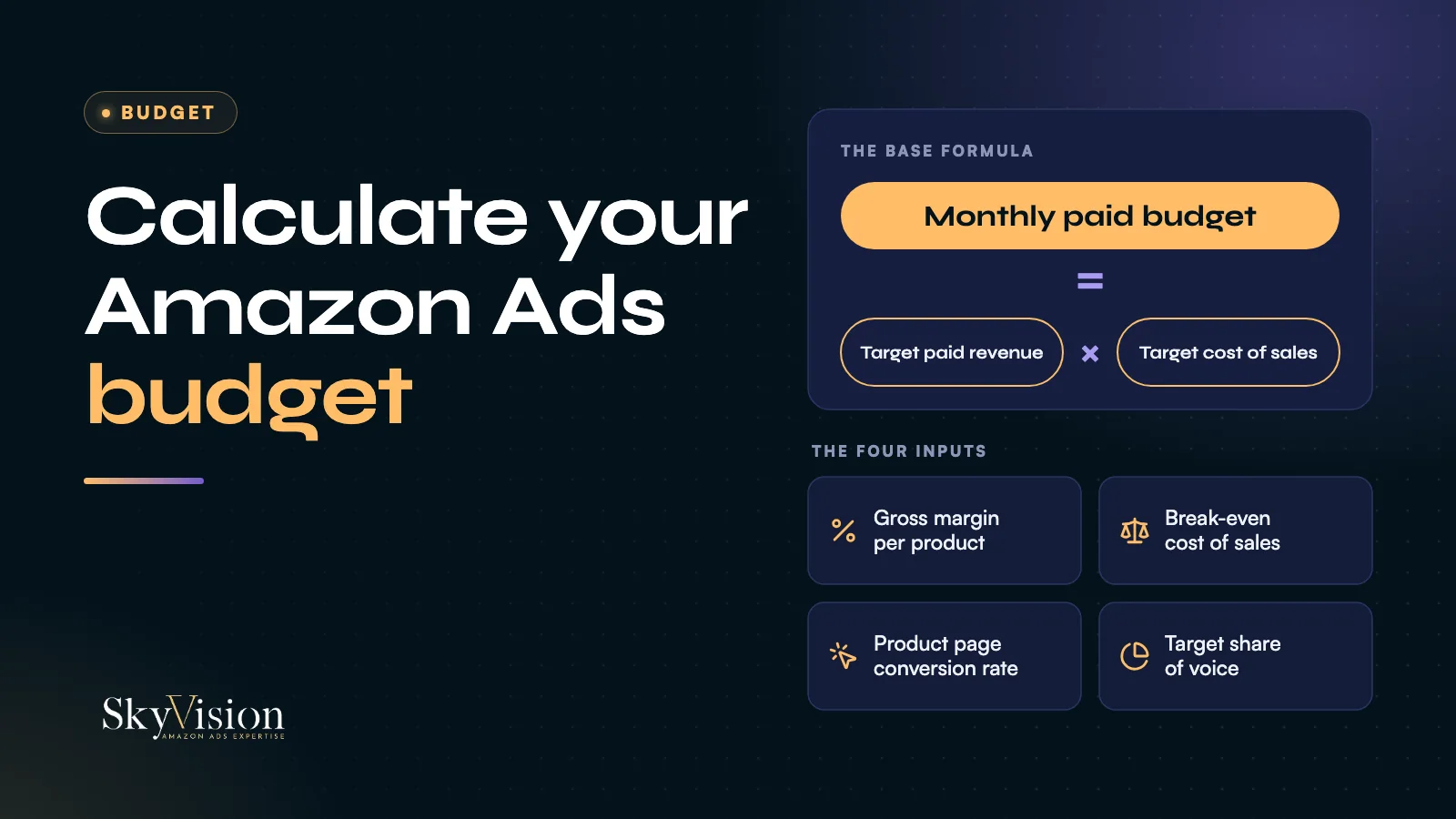
Monthly paid budget = target paid revenue × target cost of sales.
An example. You are aiming at 100,000 € of monthly Amazon revenue. You estimate that half of it will come through paid, with the rest from organic, native retargeting and branded searches. Your target advertising cost of sales is 20 per cent. So your theoretical paid budget is 100,000 × 50 % × 20 % = 10,000 € a month.
That is a starting point, not a final answer. Three things need adjusting before you fix a number.
The four inputs you need before calculating anything
Apply the formula without these four figures for your own catalogue and you get a fictional result. It is the most common mistake.
Your gross margin per product, before advertising. Product cost, FBA fees, Amazon commission which varies by category, packaging, returns. That margin dictates your break-even cost of sales. If your gross margin is 30 per cent, your break-even is exactly 30 per cent.
Your break-even cost of sales. This is the ceiling: above it, net margin turns negative. Anything below it is profitable. Above it is a deliberate investment: new-to-brand acquisition, brand defence, a launch. Not a failure signal, just a choice that has to be conscious.
Your product page conversion rate. A weak listing eats your return. You pay for clicks that do not convert. If your conversion is below 5 per cent, your first priority is not raising the advertising budget, it is auditing the listing. Otherwise you are watering sand.
Your target share of voice by category. If your three main competitors each spend 30,000 € a month on the same head terms, aiming at a 15 per cent share of voice implies a floor of roughly 15,000 €. This is the hardest figure to obtain without AMC access. See our Amazon AMC guide.
Top-down or bottom-up: which to use
Two approaches exist. Neither is better in the abstract; it depends on your situation.
Top-down. You set an Amazon revenue target, apply the formula, and get a budget. This suits you when you have a clear business objective, the financial resources available, and an established brand with a measurable funnel. The risk: if the objective is unrealistic, you burn cash for six months without reaching it.
Bottom-up. You start with a test budget, often 2,000 to 5,000 € a month depending on category. You measure return. You identify the campaigns that scale profitably and raise their budget in steps of 20 to 30 per cent a week for as long as return holds. You cut the ones that drift. This suits you when launching a brand, testing a new category, or when cash flow does not allow a heavy initial investment.
On the accounts that genuinely scale, we usually see a mix: top-down to set the annual envelope, bottom-up to steer weekly allocation. The mistake is fixing a budget in January and never touching it again. An Amazon Ads budget has to live, week by week, following performance campaign by campaign.
Apply the formula to your own case
Step 1. Write down your target monthly Amazon revenue. Realistic, not ideal. Be honest.
Step 2. Estimate your current or target paid share. A brand at launch: often 80 to 90 per cent. A mature brand with some organic: 40 to 60 per cent. A dominant brand with strong organic: 25 to 40 per cent.
Step 3. Set your target cost of sales. Calculate your break-even first, which is your gross margin as a percentage. Your target sits five to ten points below break-even if you want immediate profitability, or at break-even if you are prioritising growth and new-to-brand acquisition.
Step 4. Apply it. Budget = revenue × paid share × target cost of sales. Write the number down.
Step 5. Adjust for your format mix. If you expect more than 20 per cent in Sponsored Brands Video or Sponsored Display, whose cost of sales is mechanically higher, multiply by 1.2 to 1.4. If you are adding Amazon DSP, add 30 to 50 per cent on top of the Sponsored budget for DSP.
Step 6. Hold back 10 to 15 per cent of the budget for testing. Without that buffer you stay prisoner of your existing campaigns and miss new keywords, formats and segments.
A concrete case: recalibrating Polar
On the Polar account, the initial budget was under-calibrated for the sports technology category. After recalibrating the budget and restructuring the format mix over twelve months, return on ad spend moved from 6.4 to 10.8 and Amazon revenue grew by 203 per cent.
Results from a real client case. Past performance does not guarantee future results. Outcomes vary by catalogue, budget, category and competition.
The three calculation mistakes we see most
Confusing cost of sales with acquisition cost. Advertising cost of sales measures advertising spend against paid revenue. Real acquisition cost also takes in gross margin, returns and Amazon fees. Calibrating a budget on cost of sales without those lines produces an account that looks profitable while destroying net margin.
A neighbouring question, and a frequent one at the end of the calculation: at what budget does a programmatic channel become worth opening? We answer it in our article on the minimum budget for Amazon DSP.
Ignoring total cost of sales. TACoS (advertising spend divided by total Amazon revenue, not just paid) should fall when your advertising is working, because advertising generates an organic halo. If it rises while your advertising return looks good, you are cannibalising your own organic sales. See our seven mistakes that cap return on ad spend.
Copying a competitor's budget. Without knowing their gross margin, their format mix and their funnel, copying their budget leads to over-investment or under-investment. The only useful benchmark is your own 90-day history.
Questions we get asked
What is the minimum budget to start with Amazon Ads?
For a serious test, 1,500 to 2,500 € a month over 90 days at minimum. Below that, the data volume is too thin to optimise on. For Amazon DSP there is no single minimum: see our article on the Amazon DSP minimum budget and our complete Amazon DSP 2026 guide.
How long before I know whether my budget is well calibrated?
Four to eight weeks for Sponsored Products. Six to twelve weeks for the full mix including Sponsored Brands Video and DSP. In the first weeks cost of sales is mechanically higher: that is Amazon's algorithms learning. Do not cut too early.
Should everything go into Sponsored Products?
No. An account that is 100 per cent Sponsored Products caps its return and invests nothing in brand defence or new-to-brand acquisition. See our comparison of Sponsored Products, Brands and Display.
How do I know whether my current budget is under or over-calibrated?
Three concrete signals. Under-calibrated: your share of voice is below 10 per cent on your head terms and campaigns run out of budget before the evening. Over-calibrated: your cost of sales sits durably above break-even with no scaling plan, or more than 30 per cent of budget goes to campaigns making fewer than 50 sales a month. The free audit identifies which: book the audit.
How does this differ from your article on allocating the budget?
This one is about calculating the number: the formula, the four inputs, break-even, share of voice. Our other piece, on what budget for Amazon Ads and how to allocate it, covers what to do with that number once you have it: splitting it across formats, goals and seasonality. Read this one first.
The last word
Calibrating an Amazon Ads budget is not an exercise you freeze once a year. It is a living mechanism. Four inputs: gross margin, conversion, target cost of sales, share of voice. One simple formula. A weekly adjustment based on what the campaigns actually do.
The brands that scale best on Amazon are not the ones that spend the most. They are the ones that reallocate budget quickly and well.
For a calibration against your catalogue, your category and your objectives: a free audit, with a 30-minute call and then a written summary within about a week. See also our approach.


