.webp)

.svg)
Amazon AMC in 2026: what can you actually get out of it?
Amazon AMC in 2026: what can you actually get out of it?
Amazon Marketing Cloud (AMC) is a subject where the marketing promise runs well ahead of the operational reality for most brands. You are sold multi-touch attribution, custom audiences, DSP incrementality. But concretely: what do you get out of it today? What does it cost? Do you need a data scientist?
This guide answers those questions without the marketing speak. Based on what we see on accounts audited by SkyVision, an Amazon Ads verified partner, it gives an honest reading of AMC in 2026: what works, what does not, and when it is worth the investment.
1. What Amazon Marketing Cloud is
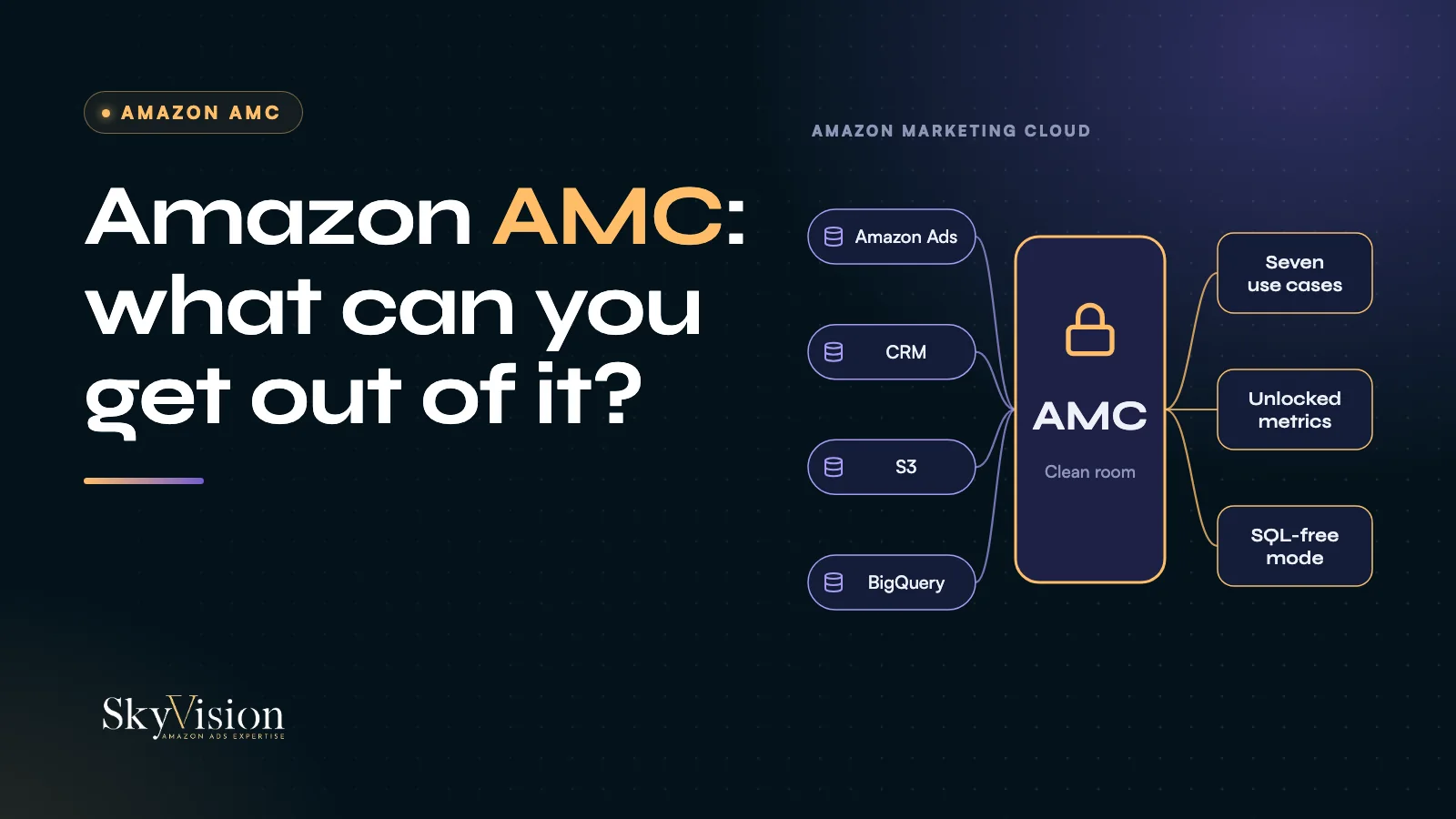
AMC is a clean room operated by Amazon Ads. It is a secure environment in which you can cross your Amazon advertising data: Sponsored Products, Sponsored Brands, Sponsored Display, DSP: with your own CRM, without that data ever leaving the Amazon environment. You run SQL queries or use pre-built templates, and you get aggregated results back.
In practice, AMC lets you answer questions the standard Amazon Ads console cannot touch:
- How many of my Sponsored Products buyers had already seen a DSP advertisement before buying?
- What is the real effect of a Prime Video advertisement on Amazon sales over the following 30 days?
- How much am I cannibalising between branded defensive bidding and organic sales?
- Which audience segments convert best and deserve to be scaled in DSP?
These are the questions that matter. Without AMC you answer them by intuition. With AMC you answer them with Amazon first-party data.
2. Why AMC is the most underused lever in the Amazon Ads stack
Three reasons explain why AMC remains underused by European brands in 2026.
The technical barrier: SQL, by default
The native AMC interface requires SQL queries to get at the data. Most B2B brands have no data scientist in their marketing team. The result is that AMC gets switched on and left unused, or used superficially through pre-built templates that do not answer the brand's own questions.
The cost: not the price tag, the analysis time
AMC itself is free for brands with an active DSP account. The real cost is analysis time: building a custom SQL analysis, interpreting it and turning it into an operational decision takes four to eight hours per use case on average. Without a method, that time is wasted.
Activation: uneven availability across agencies
AMC is technically available to every DSP account. But agencies that are not Amazon Ads partners do not necessarily have the SQL skills or the processes to get value from it. A verified partner agency generally has a mature AMC stack with internal templates tested across several accounts.
3. Seven concrete AMC use cases for B2B brands
These are the seven use cases that deliver the most operational value, in descending order of return.
DSP incrementality measurement
The question: did my DSP campaign genuinely add revenue, or did it simply cannibalise sales Sponsored Products would have generated anyway? AMC measures that halo by comparing DSP-exposed and non-exposed buyers over the same window. It is the metric that justifies a DSP budget, or ends it.
Multi-touch path-to-purchase attribution
The question: what journey do my buyers actually take? How many are exposed to DSP, then Sponsored Brands, then Sponsored Products before converting? AMC reconstructs the full path over 30, 60 or 90 days and reveals the winning combinations. It is often counter-intuitive: the paths that convert best are rarely the ones you assumed.
Custom audiences built on purchase signals
The question: how do I target genuinely qualified audiences in DSP? AMC lets you build custom audiences such as "buyers in category X who have not bought from me in 12 months", "viewers who finished my Prime Video advertisement without buying", or "cross-marketplace buyers across two countries". Those audiences can be pushed back into DSP and scaled with a level of qualification nothing else matches.
Optimised frequency cap
The question: how many times does a user need to see my advertisement before converting, and at what point are they over-exposed? AMC measures marginal return by exposure frequency. The critical threshold usually sits between five and seven exposures a week depending on category. Beyond it, marginal return collapses.
Precise new-to-brand audit
The question: what share of my Amazon sales genuinely comes from new customers rather than existing ones? AMC breaks it down by campaign, audience and inventory. This matters in a scaling phase: a new-to-brand share that collapses means you have saturated your existing base and need to move budget into pure awareness.
Cross-marketplace path analysis
The question: how many of my buyers in one country go on to buy from me in another? AMC crosses multi-marketplace data when several marketplaces are active in your Brand Account. It lets you arbitrate budget between marketplaces on facts rather than assumptions.
Brand versus organic cannibalisation
The question: when I bid defensively on my own brand name in exact match, how many of those sales would have happened organically anyway? AMC quantifies it. On the accounts we audit, it can account for a significant share of the defensive bidding budget. Cutting that waste often produces an immediate drop in total advertising cost of sales.
4. SQL-free AMC: using it without a data scientist
The major shift between 2024 and 2026 is the arrival of SQL-free approaches that put AMC within reach of brands with no in-house data engineer.
Amazon's pre-built AMC templates
Amazon Ads offers pre-built templates for the most common use cases: basic incrementality, new-to-brand analysis, frequency cap. You fill in a few parameters and get results. These cover the most frequent questions, but not the analyses specific to your business.
Third-party AMC tools: Pacvue, Skai, Helium 10
Several SaaS tools connect to AMC and offer visual dashboards that hide the SQL. Pricing generally runs between 500 and 3,000 euros a month depending on volume. The return varies: if you run one or two analyses a month, these tools are oversized for the job.
The verified partner agency route
A verified partner agency with a mature AMC stack generally offers SQL-free AMC as part of its engagement. Analyses are built by consultants, delivered as an interpreted document, and the insights become directly operational: campaign adjustments, DSP audiences, budget allocation. For most brands spending between 5,000 and 200,000 euros a month on Amazon, this is the option with the best return. See our SQL-free AMC offer.
5. Connecting AMC to your data stack (CRM, S3, BigQuery)
AMC allows first-party CRM file uploads and API connections to your data warehouses: S3, Snowflake, BigQuery. The advanced use cases follow.
CRM upload. Cross your existing customers (lifetime value, segment, status) with their Amazon behaviour to build highly qualified DSP audiences.
S3 or Snowflake connection. Export AMC results automatically into your data warehouse to cross them with your Meta, Google and TikTok data.
Looker Studio or Tableau. Surface AMC metrics in the dashboards your finance and operations leads actually read.
These integrations normally sit with your data team plus the agency for setup. Initial effort: two to four weeks for the connection. Return over six to twelve months, depending on how mature your data stack already is.
6. What AMC unlocks compared with standard Amazon Ads reporting
Here is what you see in the standard console against what you see with AMC.
Before reaching for AMC, each funnel stage needs to be judged with the right metric in the first place. We set out which, with figures, in which metric to track at each stage of an Amazon DSP funnel.
| Metric | Amazon Ads console | AMC |
|---|---|---|
| Return on ad spend | Click-through only | Click-through + view-through + incrementality |
| New-to-brand share | Campaign-level approximation | Broken down by audience and inventory |
| Path-to-purchase | Not available | Reconstructed over 30, 60 or 90 days |
| Organic cannibalisation | Not available | Quantified as a percentage |
| Optimised frequency cap | Estimated by instinct | Measured on marginal return |
| Custom audiences | Limited to Amazon templates | Built freely in SQL or advanced templates |
| Cross-marketplace | Not available | Multi-country buyer path |
The gap is wide. Without AMC you steer Amazon Ads on a partial dashboard. With AMC you have the whole instrument panel.
7. AMC's limits: data freshness, granularity, real cost
The limits worth knowing before you invest.
Data freshness: 24 to 72 hours behind
AMC is not real time. Data arrives with a 24 to 72 hour lag. For daily tactical steering you stay in the standard Amazon Ads console. AMC is for weekly and monthly strategy.
Granularity: no individual-level data
AMC is a clean room: you only get aggregated results, never user-level detail. You cannot know that a named individual saw an advertisement and then bought. You know that a given percentage of exposed users bought. That is deliberate, for privacy.
Real cost: not the price tag, the analysis time
AMC is free for active DSP accounts. The real cost is SQL analysis time, or a subscription to a third-party tool or a specialist agency. Budget anywhere from zero, if you have an in-house data team, to around 3,000 euros a month for a premium tool or a dedicated agency, depending on your approach.
8. When is AMC worth the investment?
AMC becomes relevant when at least two of the following are true.
You already run Amazon DSP with a monthly budget above 5,000 euros. Your total advertising cost of sales is above 12 to 15 per cent and you suspect organic cannibalisation. You want to optimise DSP audiences beyond Amazon's basic templates. You are in a scaling phase, with Amazon revenue growing more than 30 per cent year on year. You run a multi-marketplace strategy across several countries.
Below those thresholds, AMC is oversized: you will get more return from optimising Sponsored Products before digging into AMC.
A concrete case: Polar, AMC inside an active DSP stack
On the Polar account (sports technology), AMC is one of the methodological levers of the DSP stack that contributed to 203 per cent growth in Amazon revenue over 12 months and to return on ad spend moving from 6.4 to 10.8. AMC specifically made it possible to measure DSP incrementality, which justified the budget, and to identify defensive bidding cannibalisation, which cut the waste.
Results from a real client case. Past performance does not guarantee future results. Outcomes vary by catalogue, budget, category and competition.
Frequently asked questions about Amazon Marketing Cloud
Do you need an Amazon DSP account to activate AMC?
Yes, as standard. AMC is part of the DSP ecosystem. A few exceptions exist for brands with very high Sponsored Ads volume, to be confirmed case by case with your Amazon Ads account manager.
Is AMC available to Vendor Central brands?
Yes, on the same basis as Seller accounts: an active DSP account is required. Vendor Central brands with a substantial Amazon Ads budget generally activate AMC at the same time as DSP.
How long before AMC produces something usable?
Technical setup: one to two weeks, while Amazon validates the connection. First useful analyses: four to six weeks, the time needed to accumulate three or four weeks of usable aggregated data. Turning insights into campaign optimisations: eight to twelve weeks.
Can an agency activate AMC on my account without me going through self-service DSP?
Yes. An Amazon Ads partner agency with a DSP agency account can activate AMC on your seller account in managed mode. For brands spending between 5,000 and 50,000 euros a month on Amazon Ads, that is the fastest and least expensive route.
What are the data protection risks with AMC?
AMC is a GDPR-compliant clean room: no user-level data is shared and you only receive aggregates. Uploading your own CRM into AMC requires your own legal basis, whether marketing consent or contractual necessity. Confirm it with your data protection officer before activating.
The last word
In 2026 Amazon Marketing Cloud is the most differentiating strategic lever for brands spending more than 5,000 euros a month on Amazon Ads with an active DSP strategy. The seven use cases above cover most of the operational value: DSP incrementality, multi-touch attribution, custom audiences, optimised frequency cap, new-to-brand audit, cross-marketplace analysis and organic cannibalisation.
The critical part: AMC does not deliver on its own. Without an analysis method and without turning insights into operational decisions, it stays an underused toolbox. That is where the verified partner agency approach earns its place: a mature AMC stack, tested internal templates, and insights delivered ready to act on.
SkyVision is an Amazon Ads verified partner with a working SQL-free AMC stack. To assess whether AMC fits your catalogue, request a free audit or read our Amazon Marketing Cloud offer. For the logical next step: our complete Amazon DSP 2026 guide and our managed Amazon DSP offer.


