.webp)

.svg)
Sponsored Products vs Brands vs Display: which to choose in 2026
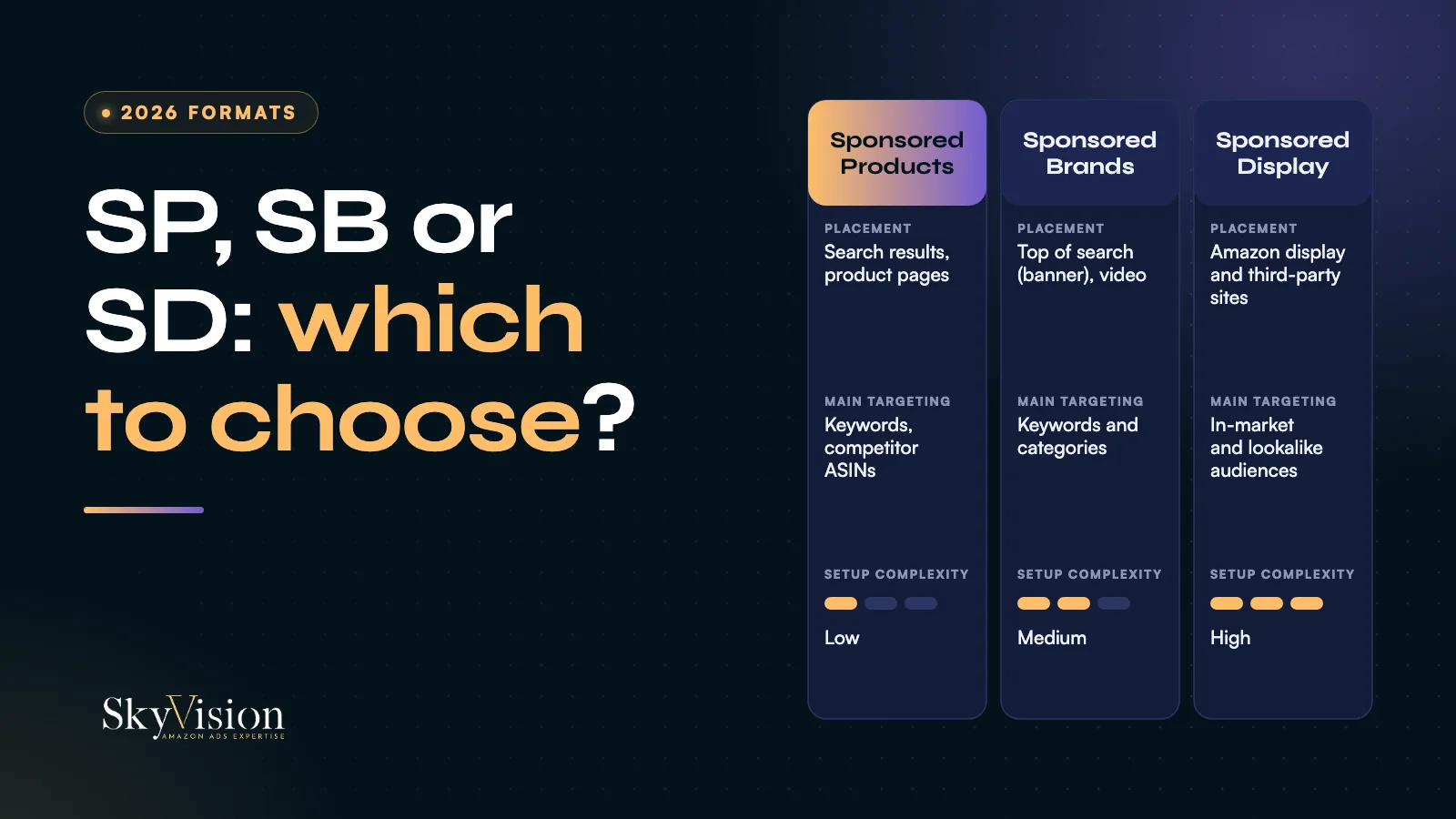
Sponsored Products vs Sponsored Brands vs Sponsored Display: the 2026 decision
Three Amazon advertising formats dominate seller accounts: Sponsored Products, Sponsored Brands and Sponsored Display. On paper they look alike. In practice they are used differently, they target distinct buying moments, and their return varies by a factor of five depending on how mature your brand is. This article settles it: when to use what, how to orchestrate them together, and which mistakes to avoid.
Update, 1 October 2026. Amazon has renamed Sponsored Display: it "is now known as display ads". Existing campaigns keep running, and Amazon says existing features are preserved. The retargeting logic described here (views, purchases) still applies.
Based on more than 6 million euros of ad budget managed since 2023 by SkyVision, an Amazon Ads verified partner, this guide describes the operational reality of 2026, without the marketing speak.
The three formats, one sentence each
Sponsored Products (SP). The text advertisement that pushes a specific product page to the top of Amazon search results. CPC. The base format, available to any Amazon seller.
Sponsored Brands (SB). The banner or video advertisement that features your brand plus three products, linking to your Brand Store. CPC. Reserved for brands with an active Brand Registry.
Sponsored Display (SD), now called display ads in Amazon Ads Agent. The display advertisement that retargets visitors on Amazon and off Amazon. CPC or CPM depending on the objective.
Three formats, three logics. The classic trap is to put everything into SP by reflex and ignore the other two. The result is a capped return and new-to-brand acquisition that stops growing.
Detailed comparison
| Criterion | Sponsored Products | Sponsored Brands | Sponsored Display |
|---|---|---|---|
| Placement | Search results, product pages | Top of search (banner), video | Amazon display + third-party sites |
| Main targeting | Keywords, competitor ASINs | Keywords + categories | Audiences (in-market, lookalike) |
| Critical metrics | ROAS, ACOS, CTR | New-to-brand %, brand search lift | View-through conversions, view-through ROAS, new-to-brand % |
| Effective minimum budget | 500 € / month | 1,500 € / month | 3,000 € / month |
| Setup complexity | Low | Medium (Brand Store required) | High (advanced audiences) |
| Main funnel stage | Conversion | Awareness + consideration | Retargeting + cross-sell |
| Access required | Any Amazon seller | Active Brand Registry | Brand Registry + minimum spend |
| Creative format | Text, pulled from the listing | Custom banner + video | Custom display, several formats |
Use cases by business objective
The right format depends on your business objective at that moment, not on personal preference.
Conversion on head terms (best sellers)
The format: Sponsored Products. You target high-intent searches on your best sellers. This is the format to master before going anywhere else. See our Sponsored Products offer.
Brand awareness on generic searches
The format: Sponsored Brands Video. You capture attention on generic queries ("sports headphones", "organic shampoo") by showing your brand plus three products plus a link to your Brand Store. Critical metric: new-to-brand share.
Brand defence
The format: Sponsored Brands on your own brand plus defensive Sponsored Products bidding. You stop competitors capturing your branded search traffic. Watch the organic cannibalisation trap: use Amazon Marketing Cloud to measure what would have converted organically anyway.
Retargeting product page visitors
The format: Sponsored Display "Views". You re-engage users who saw your listing without buying, over a 7 to 30 day window.
Catalogue cross-sell
The format: Sponsored Display "Purchases". You re-engage your own recent buyers with complementary products: tent buyers towards sleeping bags.
Scaling new-to-brand acquisition
Beyond the three formats: Amazon DSP. When you have saturated SP, SB and SD and your new-to-brand share has stopped moving, that is the signal to go full-stack programmatic. See our complete Amazon DSP 2026 guide.
Multi-format funnel strategy: how to orchestrate the three
A mature brand never runs a single format in isolation. It orchestrates SP, SB and SD together along a funnel logic.
Recommended budget split by brand stage
| Brand stage | Sponsored Products | Sponsored Brands | Sponsored Display |
|---|---|---|---|
| Early (Amazon revenue < 100 K€ / year) | 80 % | 15 % | 5 % |
| Growth (100 to 500 K€ / year) | 60 % | 25 % | 15 % |
| Mature (500 K€ to 5 M€ / year) | 50 % | 25 % | 15 % (+ DSP 10 %) |
| Scale (> 5 M€ / year) | 40 % | 20 % | 15 % (+ DSP 25 %) |
This split is a starting point, to be calibrated against your category, your margin and your seasonality. An early-stage brand putting 30 per cent into SB without a mature Brand Store is wasting budget.
Activation sequence
On an account starting with Amazon Ads, here is the standard sequence.
Months 1 to 3. Sponsored Products only: ACOS optimisation, keyword structuring, negative targeting.
Months 4 to 6. Add Sponsored Brands on category head terms plus brand defence, and build the Brand Store.
Months 7 to 9. Add Sponsored Display retargeting on listing views plus cross-sell to existing buyers.
Months 10 to 12. If volume has emerged, above 5 K€ a month across SP, SB and SD, assess adding Amazon DSP.
Skipping steps (launching SD before SP is stable, for instance) amounts to wasting budget.
Common mistakes, format by format
Sponsored Products mistakes
Everything on automatic targeting, with no transition to manual exact match on the head terms that work. No negative targeting, so ACOS drifts slowly. Bid management by instinct, with no matrix per keyword cluster. Confusing conversion with exploration: putting 100 per cent of the SP budget on head terms kills long-tail discovery.
Sponsored Brands mistakes
Launching SB without a mature Brand Store, so the click lands on a thin page. Static creative only, when video converts better and SB Video remains underused in Europe. Reading direct return only, without tracking new-to-brand share, which means missing the awareness effect. Targeting only your own brand, defensively, without extending to competitors.
Sponsored Display mistakes
Switching SD on too early, before SP and SB are stable, which spreads the budget thin. Never rotating creative, when fatigue sets in within two to three weeks. Ignoring "Purchases" audiences built from your own buyers, which wastes the cross-sell opportunity. Confusing Sponsored Display with Amazon DSP: see our DSP 2026 guide.
Where does DSP fit?
Amazon DSP is not a fourth Sponsored format. It is the programmatic tool that serves ads on Amazon properties and across the open internet: Twitch, Prime Video, Fire TV, partner sites. It complements Sponsored Products and Sponsored Brands, it does not replace them. Switch it on when your SP, SB and SD stack is mature and you want to scale new-to-brand beyond the Amazon ceiling. See our managed Amazon DSP offer.
We measured what each of these channels actually costs to recruit a new customer, on a live account: the cost per new customer channel by channel, including the figure that does not flatter us.
Recommendations by brand stage
Early brand (Amazon launch, revenue < 100 K€ / year)
Focus 80 per cent SP plus 15 per cent SB. Build the fundamentals first: ACOS under control, a basic Brand Store, optimised product listings. SD stays at 5 per cent, on listing-view retargeting only.
Growth brand (revenue 100 to 500 K€ / year)
Balance SP, SB and SD at 60 / 25 / 15. Invest in a mature Brand Store, in Sponsored Brands Video, and in SD "Purchases" audiences for cross-sell. Run first AMC tests to measure cannibalisation.
Mature brand (revenue 500 K€ to 5 M€ / year)
Full stack: SP, SB, SD and DSP. Activate Amazon Marketing Cloud for incrementality measurement and custom audiences. Consider a multi-marketplace strategy where relevant.
Scale brand (revenue > 5 M€ / year)
Full stack plus DSP at 25 per cent of budget. Add Sponsored TV (streaming TV). An in-house team, or a hybrid with a verified partner agency.
A concrete case: Polar, orchestrating SP, SB, SD and DSP
On the Polar account (sports technology), orchestrating the three Sponsored formats plus DSP contributed to moving return on ad spend from 6.4 to 10.8 and to 203 per cent growth in Amazon revenue over 12 months. No single format would have delivered that on its own. It is the mix, steered week after week, that unlocks the performance.
Results from a real client case. Past performance does not guarantee future results. Outcomes vary by catalogue, budget, category and competition.
Frequently asked questions
Do all three formats have to be switched on at once?
No. For early-stage brands, running Sponsored Products alone for three months is the right strategy. Adding SB and SD progressively avoids spreading the budget thin and lets you measure the effect of each format.
Is Sponsored Brands available to Vendor Central accounts?
Yes, since 2023, provided Brand Registry is active. Functional parity between Vendor and Seller is close to complete on SP and SB. Sponsored Display on Vendor has some audience limitations, to be checked case by case.
Which format suits a highly specialised (niche) catalogue?
Sponsored Products dominates in a niche: search volumes are moderate but qualified. SB is less effective when generic category search volume is low. SD with in-market audiences can play a role in acquiring beyond direct searches.
How should budget be split between conquest and defence?
A rule of thumb: no more than 15 to 25 per cent of budget on defensive bidding, meaning SP and SB on your own brand. Beyond that you are cannibalising organic. Amazon Marketing Cloud measures the paid-to-organic ratio on your brand precisely.
Is a Partner agency worth it if I only run SP?
Even on SP alone, a Partner agency unlocks automated bid matrices, rigorous negative targeting, a product listing audit and structural ACOS optimisation. The return on an agency versus running it yourself shows up as a lift in return on ad spend and as time freed.
The last word
The right Amazon Ads format depends on your business objective at that moment and on your brand stage. Sponsored Products is the universal base. Sponsored Brands unlocks brand awareness. Sponsored Display, now called display ads, opens retargeting and cross-sell. Orchestrated together, the three build a profitable funnel. Beyond them, Amazon DSP scales new-to-brand acquisition on premium inventory.
The critical part is not skipping steps. Launch SP, stabilise, add SB, measure, add SD, measure, then assess DSP. That calibrated sequence avoids the blind steering that characterises most of the accounts we audit.
SkyVision is an Amazon Ads verified partner, having managed more than 6 million euros of Amazon ad budget for B2B brands since 2023. To assess the right mix for your catalogue, request a free audit or read our approach.


