


Awareness, consideration, conversion: the logic of e-commerce ads
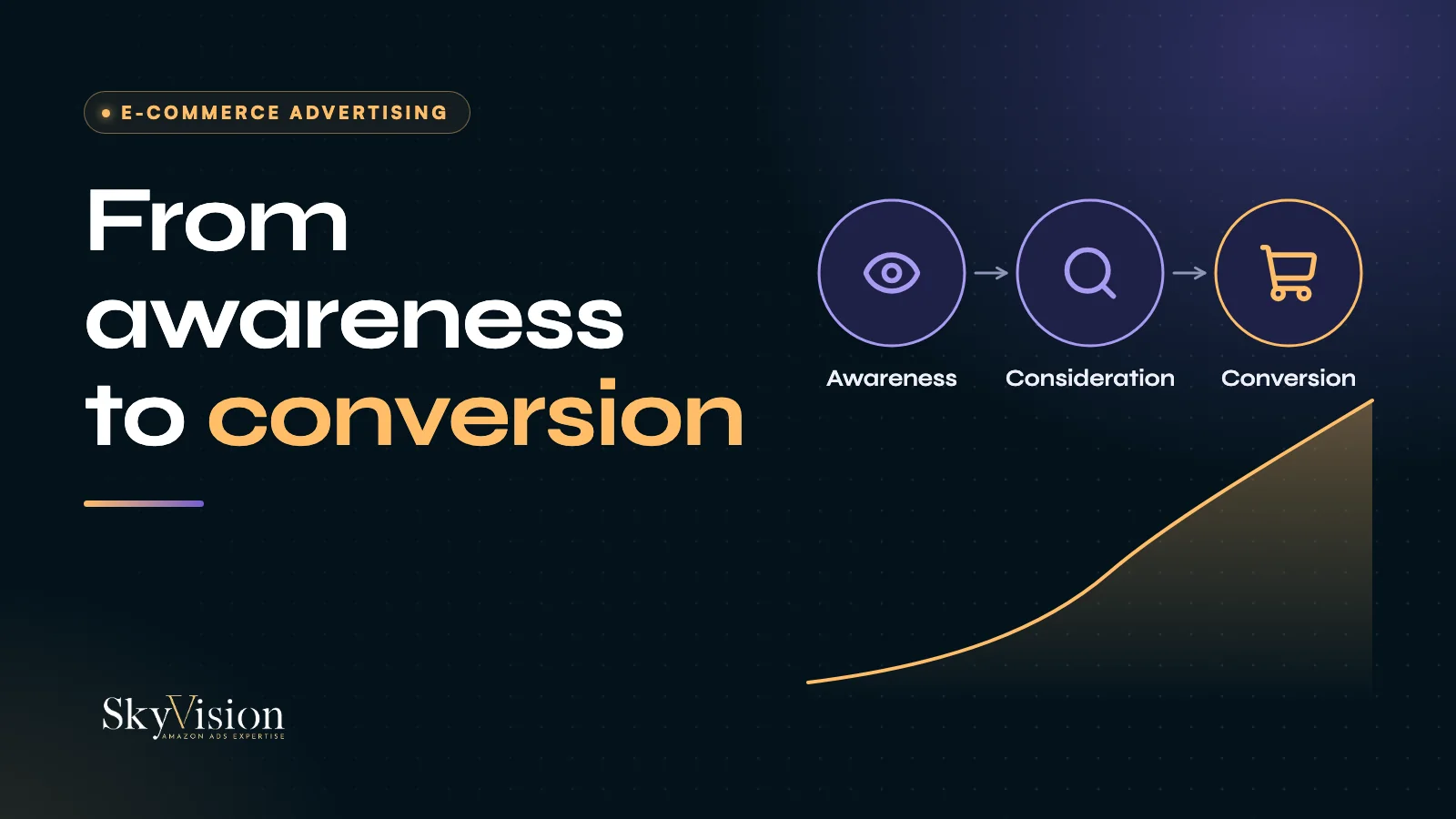
You may be judging all your campaigns with the same number. Yet an ad that makes your brand known and an ad that triggers a purchase do not do the same job.
SKYVISION is an agency specialised in Amazon advertising, so our view is biased, but this reasoning applies to Meta, TikTok and Google as much as to Amazon. Erwan, co-founder of SKYVISION, goes through it in this video (7 minutes 55, in French with English subtitles):
A customer travels, they do not follow a tunnel
Erwan starts from an image. A traveller crosses an unfamiliar city. First they spot a sign in the distance, then they stop in front of the window, then they walk in to buy. Online it is the same: awareness, consideration, conversion.
This is not a strict chronological sequence. Someone can discover your brand today, see a second ad tomorrow and buy right away, or come back a month later. Platforms record every action (a view, a click, an add to cart) and place the person in a cold, warm or hot audience. Your job is to show the right ad at the right temperature: broad and attractive when the customer is cold, more precise when warm, tightly targeted when ready to buy.
The video's example, an illustration and not a measurement. A user watches a Meta video of your new perfume: they enter the awareness audience. Two days later they click a TikTok ad showing reviews: consideration. The following week they type your brand name on Amazon and land on a Sponsored Products campaign: conversion.
Awareness: get seen, and judge it by CPM
You have just opened a shop on a busy street, and nobody knows you are there. Before selling, you have to catch people's eye. Erwan's indicator is the CPM, the cost per 1,000 impressions: what you pay for 1,000 relevant people to see your brand.
The video mentions short video on Meta and TikTok, YouTube or Display on Google, and on Amazon video Sponsored Brands or a DSP campaign, which also shows outside Amazon.
An example from the video, with illustrative figures that are not market benchmarks: a cosmetics creator launches a cream and puts €2,000 on TikTok at a €2 CPM. That makes 1 million targeted impressions (2,000 ÷ 2 × 1,000). They are not trying to sell right away: they want to be recognisable when people look for a cream a few weeks later. You feed the top of the funnel to prepare what follows, without staying there forever.
Consideration: make people want to compare
The window draws a crowd. Now passers-by have to stop and look closer. Does curiosity turn into action? Three indicators:
- CTR, the click-through rate: of those who see the ad, how many click;
- CPC, the cost per click: what each visit costs;
- micro-conversions: clicks to the product page, adds to cart.
The video mentions video retargeting or carousels on Meta and TikTok (demonstrations, testimonials), generic search on Google, and on Amazon Sponsored Brands on a broad keyword or Sponsored Display to retarget product page visitors.
A useful diagnosis: if the click-through rate is good but few people add to cart, the problem often comes from the product page, not the ad. In the video's example, a clothing brand retargeting on Meta sees its click-through rate rise while add to cart stays low. It adds a guide and better photos, and add to cart goes up. The problem was not traffic but the offer and how it was presented.
This stage filters out the merely curious and exposes friction: product page, price, reviews. The stronger your click-through rate and conversion rate, the less conversion will cost, according to Erwan.
Conversion: trigger the purchase
The customer has walked in, looked and compared. The stake is simple: every euro invested must bring back more than it costs. Four indicators:
- final CVR, the conversion rate at purchase (per session; on Amazon, it is orders);
- ROAS: how much revenue €1 of advertising generates;
- CPA: what each acquired customer costs;
- TACoS, tracked on Amazon: ad spend set against total revenue, organic sales included.
Erwan insists on TACoS because it shows whether advertising also boosts organic sales: on Amazon, he says, advertising helps ranking, which benefits organic sales in parallel.
On the application side: on Amazon, Sponsored Products on precise keywords, possibly with coupons (our comparison of Sponsored Products, Brands and Display helps you choose). On Meta and TikTok, purchase or catalogue campaigns. On Google, exact-match search and Shopping, where purchase intent is strongest.
In the video's example, a sports accessories seller refines their keywords and secures the Buy Box: their ROAS stays stable while their TACoS falls. That is a sign, according to Erwan, that organic sales are taking over. Conversion is therefore not only the immediate purchase: it also shows whether awareness and consideration prepared the ground.
The mistake: judging each stage with the wrong metric
What follows extends Erwan's second question ("which single indicator proves the stage is working?"); the two cases below are ours, not the video's.
A simple mistake follows from this. If you judge an awareness campaign by its ROAS, you ask it to do the work of conversion. If you judge a conversion campaign by its number of impressions alone, you do not know what it brings in. You risk cutting a campaign that is doing its job.
For a worked example on an Amazon DSP account, read our article on Amazon DSP funnel metrics, which judges each stage with its own metric.
Splitting the budget with three questions
The three stages run in parallel. Every day, some people discover you, others compare you, others buy. The weight changes: more awareness when you launch a product, more consideration when the audience warms up, more conversion when the brand is recognised.
Before each spend, Erwan suggests three questions:
- Which stop is this audience at?
- Which single indicator proves the stage is working?
- What can I do to move them to the next stage?
That is his compass: it lets you read the numbers in the right order, whatever the platform.
Frequently asked questions
Do the three stages have to happen in order?
No. They run in parallel: the same person can discover your brand, compare and buy within a few days, or come back a month later.
My click-through rate is good but nobody adds to cart: what should I check?
The product page first: guide, photos, price, reviews. Erwan explains that the problem often comes from there, not from traffic.
To go further on the numbers, read our method for calculating your real CAC in e-commerce and our article on the mistakes that destroy an e-commerce brand.


