


Real CAC in e-commerce: how to calculate it in 3 levels
Your ad manager shows, say, €35 per purchase, everything seems to hold, and yet your bank account tells a different story. Most of the time, the number you call CAC is not CAC.
SKYVISION is an agency specialised in Amazon advertising, so our view is biased, but the method below works for any acquisition channel. Erwan, co-founder of SKYVISION, walks through it in this video (13 minutes, in French with English subtitles):
Platform CPA and real CAC: two different numbers
Platform CPA is what Meta, Google, TikTok or Amazon report: how much you paid on that channel for a sale the tool credits to itself. Erwan calls it the price of the entry ticket. Real CAC is the ticket plus everything you paid around it for that customer to show up and buy.
A test. Can you answer two questions without hesitating? How much does a new customer cost you, creative, promotions, returns and support included? How many new customers did you actually get over the period? If you get stuck, your CAC is an illusion. That is common, and it can be fixed.
The seven layers of real CAC
Erwan suggests seeing CAC as an addition of seven lines, when most brands only look at one, advertising.
- Media: Meta, Google, TikTok, affiliates, retail media.
- Creative: creator content, shoots, editing, iterations, hooks.
- Fees: freelancers, agency, in-house team.
- Tools: tracking, product feeds, landing page builder, attribution.
- Acquisition promotions: codes, gifts, delivery costs that you absorb yourself.
- Returns and losses: refunds, breakage, customer service, chargebacks.
- Imperfect measurement: attribution that gets it wrong leads to poor decisions and wasted spend.
Here is the example from the video. These are illustrative figures, neither a client result nor a market average. You spend €20,000 on advertising, €6,000 on creative, €3,000 on fees and tools, €4,000 on promotions and €2,000 on returns and fraud. Total: €35,000. For 200 customers, that is €175 per customer. The platform may show €80, but your business lives on €175.
The three levels of measurement: platform, blended, net
To take back control, Erwan argues for three numbers, not fifteen.
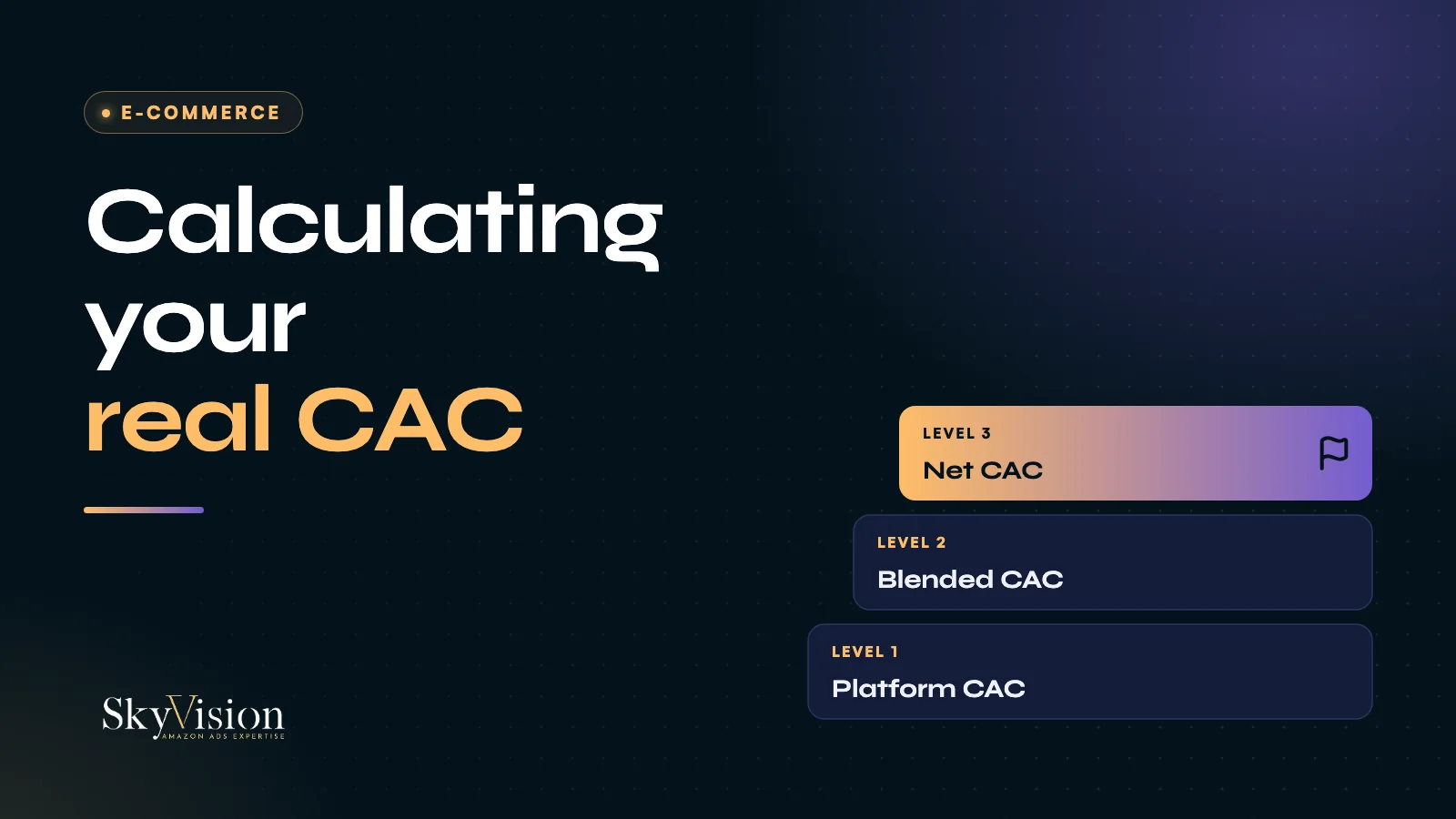
- Platform CAC: the cost per purchase each channel reports. It is for optimising a campaign, not for running the business, because each platform only sees its own piece of reality.
- Blended CAC: all your acquisition spend (media, creative, fees, tools, promotions) divided by the number of new customers. This is the CAC you steer by, the one that tells you whether you are winning customers at a sustainable cost.
- Net CAC: blended CAC corrected for whatever cancels the value of the sale, meaning returns and refunds, promo codes that eat into the figure, subsidised shipping, fraud and chargebacks. A customer acquired on a refunded order still cost you their acquisition, and the sale is gone.
In the video's example, the €175 already includes the €2,000 of returns and fraud: it is a CAC that counts losses, not just advertising.
CAC is not margin. CAC is what you pay to get a customer, margin (or contribution) is what you keep on an order. Compare them without mixing them up. If your CAC is higher than what the first purchase brings in, you need repeat purchases, a higher average basket or fewer losses. If it is lower, you can speed up as long as the figure stays stable.
Two tracking rules. Every week, look at blended CAC: total acquisition spend and new customers. Every month, work out net CAC with returns, promotions and disputes, and compare it with the real profit on the first purchase. That way a flattering ROAS stops trapping you.
The scissors effect
To simplify, CAC is the cost of traffic divided by the conversion rate. So it can blow up without your CPCs blowing up. Example from the video: the cost of traffic rises 10% and the conversion rate falls 6%. CAC does not rise 10% but about 17% (1.10 ÷ 0.94 ≈ 1.17), because a higher cost is divided by a lower efficiency. For example, a €100 CAC would become about €117, before even counting returns, which push net CAC up faster still.
The dashboard shows it poorly: CPM fine, CPC fine, ROAS not bad, and the profit vanishes. The algorithm optimises what it sees. Your business also pays for what it does not see: promotions, returns, support, disputes.
Why CAC rises, even when you optimise
Erwan compares acquisition to a property market: you buy space, impressions, clicks, attention, and that space gets more expensive. He puts forward six structural causes.
- More money in the auctions: when the advertising market grows, the average price rises mechanically.
- Ad inventory getting more expensive: even if your account holds for a while, the general current pushes upward.
- Retail media: it captures a growing share of budgets, and many brands first pay to create demand, then pay again to capture it on marketplaces.
- The big budgets of some players: they push costs up across a whole country, even for those who do not sell the same product.
- Falling conversion: CAC rises even if CPMs stay flat, because the damage happens at checkout, with massive basket abandonment.
- Post-purchase costs: you pay for the acquisition of orders that end in a return, a dispute or a refund. Platform CPA stays stable, net CAC climbs.
So CAC does not rise for one reason alone: it is an addition of pressures.
Five levers to bring it down
You will not win just by trying to push CPMs down. You win by cutting losses and raising the value of each customer.
- The offer. Raise the average basket before touching the ads. If you sell a €30 product with a €25 CAC, your first move is not better targeting: think bundles, discovery packs, logical cross-sells, three-tier price anchoring.
- Conversion. Remove one friction rather than adding ten: a clear promise, strong proof (before and after, reviews, demonstration), explicit delivery and returns, one obvious call to action. Too many badges and pop-ups create doubt.
- Creative. A creative system weighs more than good targeting. For example, four angles (price, proof, emotion, demonstration), ten hooks per angle, one iteration a week, with creative treated as a product: test, eliminate, improve.
- Customer value. Look for a profitable CAC, not a low one. If your product gets repurchased, monetise the post-purchase: welcome message, abandoned basket, post-purchase follow-up, repurchase at 30, 45 or 60 days.
- Returns. Realistic photos, size guides, compatibility information, precise descriptions, customer service that resolves quickly. Every point of returns removed is net CAC recovered.
Frequently asked questions
What is the difference between CPA and CAC?
CPA is the cost per purchase shown by a platform for the sales it credits to itself. Real CAC adds everything around acquisition: creative, fees, tools, promotions, returns and losses.
Which CAC should you track, and how often?
Blended CAC every week, for the health of acquisition. Net CAC every month, for your decisions, compared with the real profit on the first purchase.
Why is my CAC rising when my CPCs are stable?
Because CAC also depends on the conversion rate and on returns. Slightly pricier traffic divided by a slightly lower conversion rate pushes CAC up more than either number taken alone.
For the cost of a new customer on Amazon, read our article on the cost per new customer on Amazon, and for the indicators to track at each stage, the Amazon DSP funnel metrics.


