


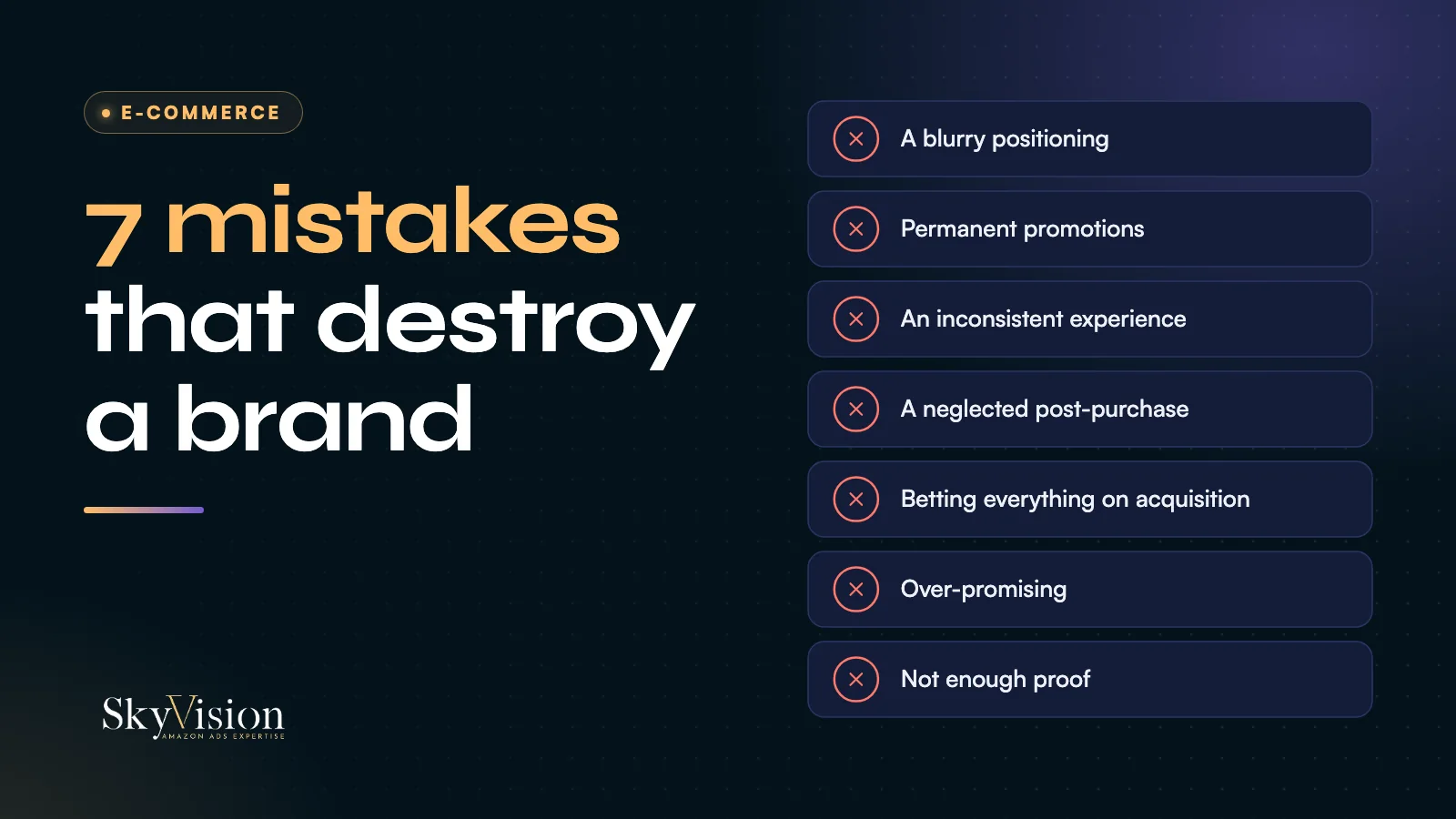
7 mistakes that destroy your e-commerce brand, even with a good product
You have a good product, decent reviews, a clean website. And yet you need a bit more ad budget every month to make the same revenue.
Advertising is not always the real problem. Often the brand has not created preference: under the slightest pressure (competition, inflation, endless choice), it becomes interchangeable.
SKYVISION is an agency specialised in Amazon advertising, so our view is biased. These seven mistakes apply just as much to an online store as to a brand that sells on Amazon. Erwan, co-founder of SKYVISION, goes through them in this video (12 minutes 47, in French), and we draw a 7-day plan from it at the end of the article:
Why a good product is not enough
A product can convince once. A brand has to convince twice: at purchase, then at repurchase and recommendation. Many brands lose right there, because they confuse making a sale with creating preference.
A brand is not a logo, a style guide or even a website. It is what a person feels when they have to choose between you and a competitor. Erwan sums it up in three ingredients: trust (do you keep your promise?), consistency (does everything tell the same story?) and experience (is it simple and clear, before and after the purchase?).
His image: two cafés side by side, same beans, same machine, but a queue outside only one. The coffee is not better there. Customers simply have a reason to go there rather than elsewhere.
Mistake 1: a blurry positioning
Without a sharp positioning, you become interchangeable. The customer compares price, delivery and reviews, and you end up doing what everyone does: promotions, bundles, limited offers. "Premium quality" says nothing, anyone can write it.
Try this test: hide the logo and the brand name on your homepage. Can a visitor guess the value you bring, and for what kind of customer? If not, your site looks like a template. Erwan's rule fits in one sentence: we help whom, to get which result, in which situation, thanks to which credible difference. It forces you to give up part of the market, and that is exactly what makes a brand.
Mistake 2: permanent promotions
Promotion disguises itself as a solution. It works once, you see the sales spike, you do it again, and you end up teaching your market never to buy at the normal price. Erwan compares it to a restaurant that would show a discount every day on a delivery app: the room fills up, but the day it wants to sell at the real price, that will be compromised.
The symptom: your sales outside promotions are weak and almost all your revenue sits in promotion periods. A rare promotion, explained and tied to an event (launch, bundle, clearance, anniversary), is not a problem. Otherwise, build value: proof, service, a guarantee, a real experience. That is the best way to justify a price instead of lowering it.
Mistake 3: an inconsistent experience
One of the fastest ways to damage a brand is to have four: one in your ads, one on your site, one in your emails, one in support. A typical example: a minimalist, reassuring ad, then a page full of pop-ups, countdown timers and aggressive discounts. Your click-through rate can stay good while trust cracks.
There is no need to write a forty-page brand book. Erwan suggests a very simple consistency guide: one promise sentence, three proofs, three words that define the tone, one offer rule. Then you apply it everywhere.
Mistake 4: a neglected post-purchase experience
Many brands do not die for lack of sales, but for lack of returning customers. The customer bought, then silence. Or worse: a vague delivery date, no tracking, a late parcel, a complicated return, surprise fees. They do not insult you in a comment, they simply never come back. From the introduction, Erwan warns that the most dangerous mistake is the one your dashboards do not show, because it happens after the purchase.
Three questions are enough. Does your customer know when the parcel arrives without asking you? Can they return an item in two minutes without negotiating? Does your support answer like a serious brand, or like a mere support ticket? Fixing this can increase repurchases and reviews, and bring down your blended acquisition cost.
Mistake 5: betting everything on paid acquisition
When everything rests on paid acquisition, the business is fragile: a bucket with no reserve that you have to fill every day. As soon as you cut advertising, revenue collapses. You have not built preference, you have built a dependency.
Erwan's rule: it is not advertising or brand, it is advertising and brand. His bare minimum: three messages that come back everywhere (promise, proof, difference), three reusable pieces of content (a demonstration, a comparison, a behind-the-scenes) and one asset you control, such as your emails and a careful post-purchase experience.
Mistake 6: over-promising
The customer does not judge your product on what it is, but on the gap between what you promised and what they receive. An ad that sells a miracle manufactures a disappointed customer, even with a good product. It looks profitable at first, since the ads convert. The bill comes later: returns, support requests, negative reviews.
Fewer promises, more proof. Show a real demonstration, detailed reviews, clear limits, and an honest FAQ that also says when the product is not a fit.
Mistake 7: not enough proof
For Erwan, branding is not a pretty visual: it is proof, plus repetition, plus consistency. The customer takes a risk (their money, their time, their disappointment) and looks for reassurance. Many consumers read reviews before buying, and a lack of reviews can block the purchase.
The proof that weighs most, according to the video: a video demonstration, detailed reviews with context (not just "great"), raw customer content, honest comparisons, clear guarantees. The test: on your product page, can you prove the promise in ten seconds, without reading? If not, the customer fills the gap with doubt.
The mini-audit in seven questions
Take your website and answer yes or no.
- Is your positioning clear? For whom, which result, which difference?
- Can you sell without a promotion, at least part of the week?
- Is your experience consistent, from the ads to support?
- Is your post-purchase experience solid: clear delivery date, simple tracking, easy return, fast support?
- If you pause your ads for a while, do you still sell?
- Are your promises credible and proven, not just written?
- Is your proof visible within ten seconds?
With three "no" answers or more, the video concludes that you have a brand problem. It is a starting point to decide where to act, not a numerical diagnosis. Erwan ends on one idea: a brand is a promise kept everywhere, and above all after the purchase.
A 7-day plan to fix it
The video gives a fix for each of the seven mistakes. Taken in the order of the video, they make a one-week plan, one mistake per day. That day-by-day split is this article's, not a schedule from Erwan. If the mini-audit gave you some "no" answers, start with those mistakes.
- Day 1, positioning. Hide the logo and brand name on your homepage, then write your sentence: we help whom, to get which result, in which situation, thanks to which credible difference.
- Day 2, promotion. Compare your sales with and without promotions. Keep only promotions that are rare, explained and tied to an event. For the rest, build value: proof, service, guarantee, experience.
- Day 3, consistency. Write the consistency guide: one promise sentence, three proofs, three words for the tone, one offer rule. Apply it to the ads, the site, the emails and support.
- Day 4, post-purchase. Answer the three questions: does your customer know when the parcel arrives without asking you, can they return an item in two minutes, does your support answer like a serious brand? Fix what snags.
- Day 5, advertising and brand. Define three messages that come back everywhere (promise, proof, difference), three reusable pieces of content (a demonstration, a comparison, behind the scenes) and one asset you control, such as your emails and a well-run post-purchase experience.
- Day 6, promises. Remove what you cannot prove. Add a real demonstration, detailed reviews, clear limits and an honest FAQ that also says when the product is not a fit.
- Day 7, proof. Test your product page: can you prove the promise in ten seconds, without reading? Put forward the proof that weighs the most: video demonstration, detailed reviews, raw customer content, honest comparisons, clear guarantees. Then redo the mini-audit.
Frequently asked questions
Should you stop all promotions?
No. A rare promotion, explained and tied to an event, remains acceptable. The problem is the permanent promotion, which teaches the market never to buy at the normal price.
What is the most dangerous mistake?
Erwan describes it as the one your dashboards do not show, because it happens after the purchase: that is the post-purchase stage (mistake 4), where a disappointed customer simply does not come back.
Can you fix these mistakes in a week?
Not entirely. The plan above is a starting point: one mistake per day. It kicks off the work without promising a result, because positioning and post-purchase care keep needing work over time.
How do I know if my positioning is clear enough?
Hide your logo and brand name on your homepage: a visitor should be able to guess what you bring and for what kind of customer. You should also be able to say it in one sentence.
To look at the advertising side too, read our article on the seven mistakes holding your Amazon return on ad spend down, the one on why increasing your Amazon Ads budget no longer grows your revenue and our comparison Amazon or Shopify.


