


Amazon Vendor advertising: the method behind a real case
As a Vendor, Amazon buys the brand's products and resells them itself: does that change how you run advertising compared with a seller? A Vendor account we manage gives some answers, with its figures and its limits.
SKYVISION is an agency specialised in Amazon advertising, so our view is biased. This article draws on the Energie Fruit case study, signed by Erwan and Quentin, co-founders of SKYVISION, from Amazon Ads API data. Energie Fruit is a hair care brand sold by Bloomup and listed as a Vendor on Amazon.fr. SKYVISION took over its advertising account in March 2025. The study covers Sponsored Ads advertising: DSP is not in these figures. The full detail is on the Energie Fruit case page.
What being a Vendor changes
According to the Amazon Ads guide and FAQ (pages read in October 2026), a vendor sells its items directly to Amazon, which then sells them to customers. A seller manages its products in Seller Central and sells directly to customers. For advertising, these pages state three things:
- registration is done with your Vendor Central account;
- Sponsored Products and Sponsored Brands are open depending on the vendor type, and brand Stores to those who sell products on Amazon;
- enrolment in Amazon Brand Registry is not required of vendors.
Amazon also states that a sale is credited to a campaign if the shopper buys within 14 days of clicking the ad. These pages say nothing about how to run the account. To steer the account we track two figures, because advertising sales are only a share of the brand's sales. ROAS tells you what each euro of ad spend returns. TACOS relates ad spend to the brand's total revenue, the sell-out, meaning all of its sales on Amazon.fr. The case below tracks both.
The figures: before and after we arrived
The two detailed comparisons below set a period of 2025 against the same period of 2024, before we arrived. Second half of 2025 versus second half of 2024, on Amazon.fr:
- total revenue: 51% more;
- advertising sales: 3.7 times more;
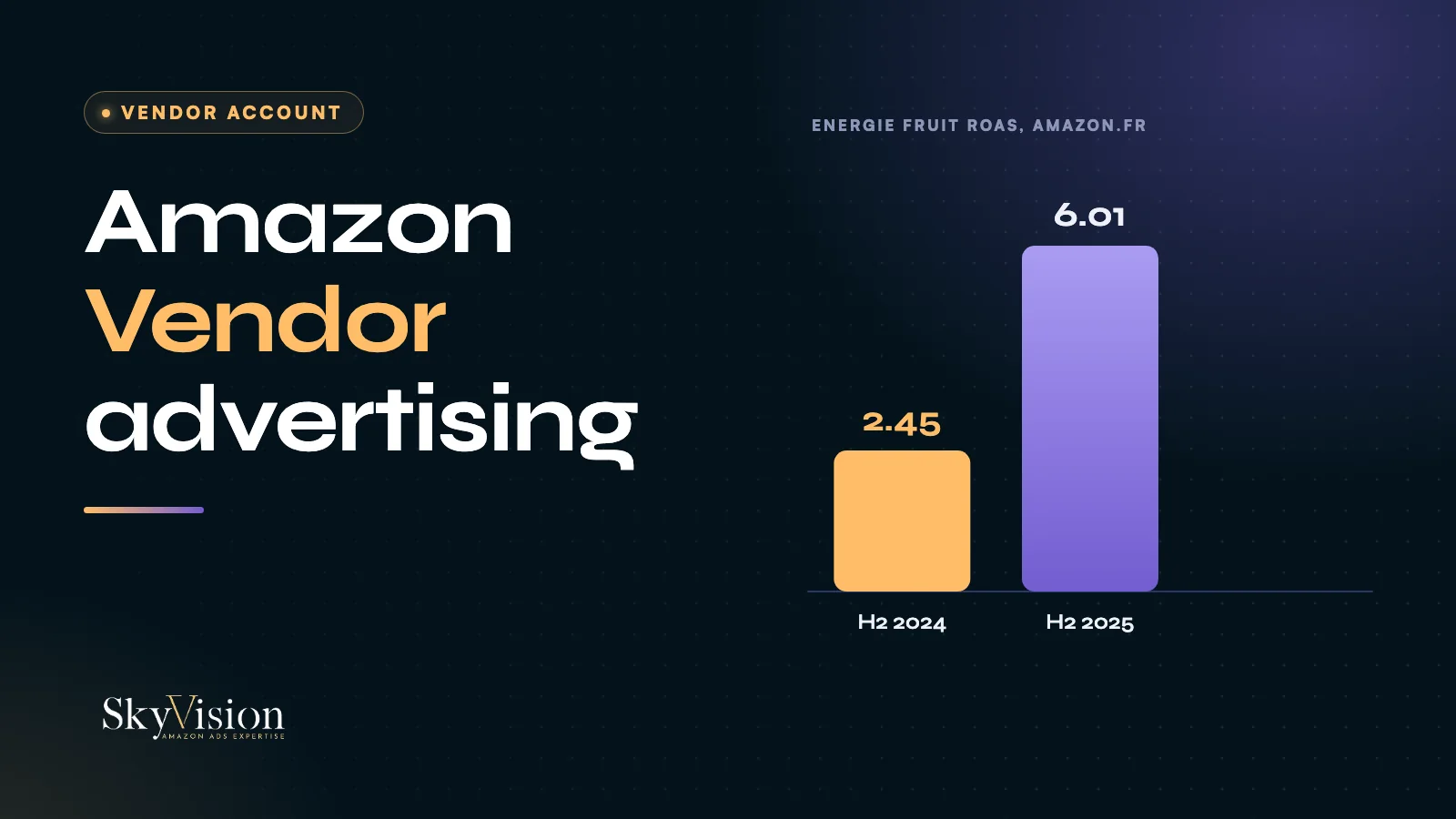
- ROAS: 2.45, then 6.01.
According to the study, the share of revenue going to advertising stayed the same between the second half of 2024 and the second half of 2025: growth did not cost more in proportion. Over a longer period, August 2025 to September 2026, all 11 comparable months grew against the same month a year earlier. January, April and May 2026 are not counted: the matching month of 2025 has no complete revenue figure. From March 2026 on, the 2025 comparison month was already managed by SKYVISION.
November 2024 versus November 2025, same Black Friday, on Amazon.fr (advertising, then total revenue):
- advertising spend: 9% less;
- advertising sales: 150% more;
- ROAS: 2.10, then 5.74;
- TACOS: 14.05%, then 7.10%;
- total revenue: 80% more.
In the same study, the conversion rate goes from 19.1% to 37.2% and the cost per click falls by 20%.
Results based on a real client case. Past performance does not guarantee future results. Results vary with the catalogue, the budget, the category and the competition.
The method, in four choices
1. Profitability first
A TACOS ceiling was set from the start, to be defended during peak events. In November 2025, the study says part of the budget planned for Black Friday was not spent, to protect profitability.
2. Follow the traffic, not the calendar
December 2025 drew more beauty traffic than November, and the budget followed. The month's revenue is the account's record.
3. Build the brand, not only the listing
The brand Store was promoted every month. In February 2026 it gained 51% in visits and 40% in sales over one year, according to the study.
4. Data-backed decisions, followed up
Each month, decisions are made product by product, then checked the following month against the budget actually spent. What does not pay is reported to the client: the study cites competitor targeting in late 2025.
What this case does not prove
- It does not say the method works on every Vendor account: this is one brand, one category, one account.
- Total revenue does not come from advertising alone. It includes all of the brand's sales, and the catalogue changed: the study mentions at least one product launched in February 2025, so absent from the 2024 base.
- The detailed comparisons cover two specific periods, the second half-year and the month of November. Another period can give another result.
- It says nothing about DSP: the advertising sales above come from Sponsored Ads advertising, and nothing in them is attributed to DSP.
What comes next: more budget, DSP decided
In the third quarter of 2026, according to the study, the brand's advertising budget is up over one year, for a ROAS of 7.6 that the study calls stable. The brand did not add it: it took it from its other media and placed it on Amazon. Opening DSP is decided for 2027, based on the results obtained in Sponsored Ads. Our complete DSP guide explains what that tool adds.
Applying the logic to your Vendor account
- Write down your two reference points before touching the campaigns: advertising ROAS and TACOS. For the second, you need to see the brand's total sales.
- Set a TACOS ceiling before the peak event, and decide in advance what you will do if it is passed: cut, cap or let it run. For Black Friday, also read our article on Black Friday ROAS.
- Look at your own sales month by month: the month that draws the most traffic is not necessarily the one on the promotional calendar.
- Give the brand a place, with a Store promoted every month, on top of the product listings.
- Each month, decide product by product, check the decision against the budget actually spent the following month, and note what does not pay.
Frequently asked questions
Can you advertise on Amazon as a Vendor?
Yes. According to Amazon Ads, registration is done with your Vendor Central account, and Sponsored Products and Sponsored Brands are open depending on the vendor type. Check your criteria on the Amazon Ads pages, which can change.
Should you track ROAS or TACOS?
Both, because they answer two questions. ROAS judges advertising campaign by campaign. TACOS judges its weight in the brand's total sales. In the Energie Fruit case, both move the right way between November 2024 and November 2025.
What TACOS should you aim for?
There is no universal figure. Energie Fruit's ceiling belongs to that account, it is not a benchmark. Start from your margin and your current TACOS.
To go further: the Energie Fruit case, in-house or agency for Amazon Ads and our case studies. Want to see where your account stands? Our Amazon Ads diagnostic is complimentary.


