.webp)

.svg)
In-house or agency for Amazon Ads: the 2026 decision
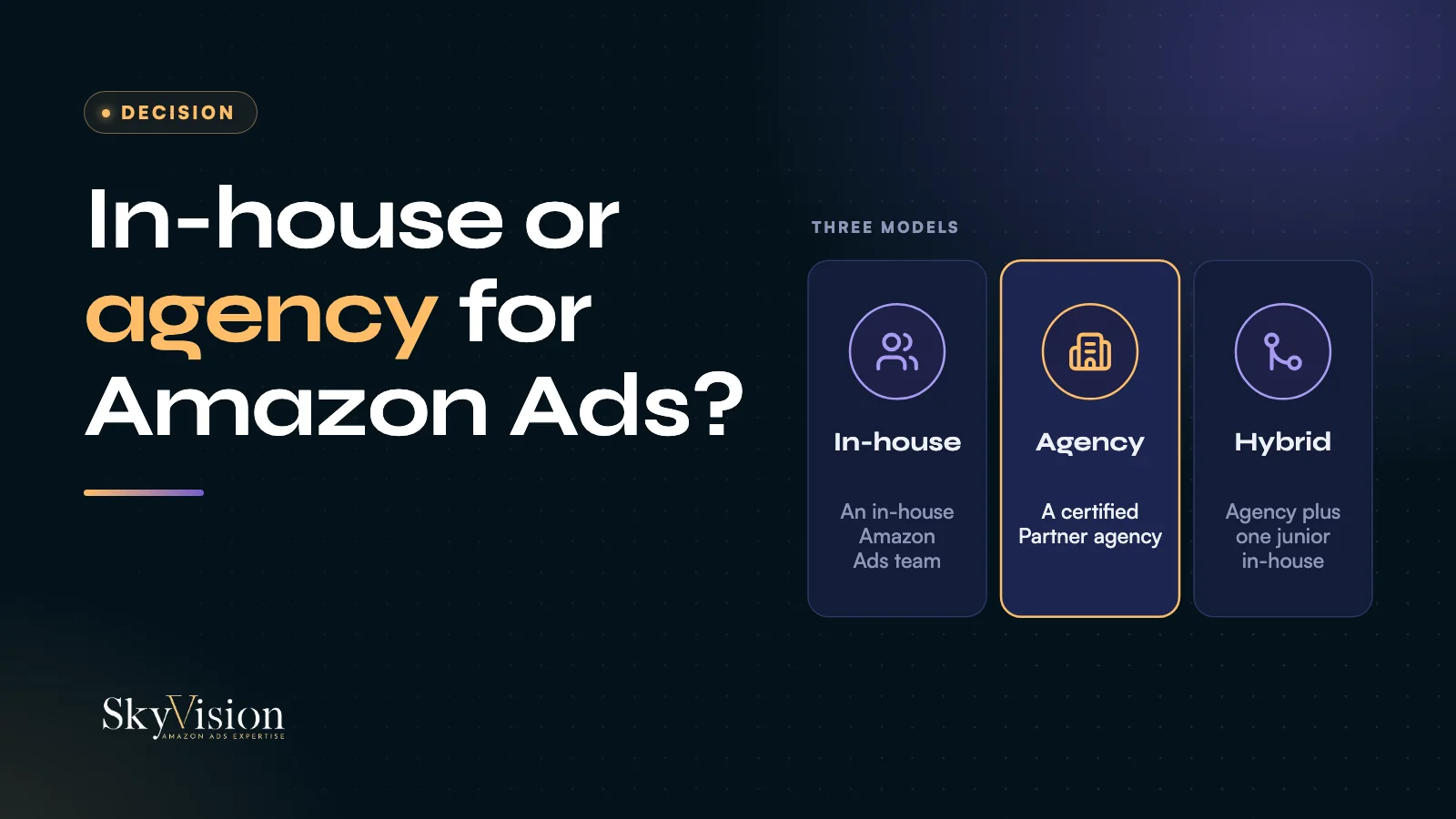
In-house or agency for Amazon Ads: the 2026 decision
Any B2B brand passing 150 K€ of annual Amazon revenue eventually asks the question: should Amazon Ads management be brought in-house or handed to an agency? The quick answer, "it depends", is not good enough. This article sets out a rational decision framework based on real costs, measurable return and the traps in both models. Written for the finance, operations and e-commerce leads who have to make the call in 2026.
The real costs: Partner agency against an in-house team
The first mistake is comparing an agency budget with a salary. The real cost of an in-house team goes well beyond the salary line.
Total cost of one senior in-house Amazon Ads hire (France, 2026)
Gross annual salary: 50 to 75 K€, junior to senior. Employer contributions: around 42 per cent, so 21 to 31.5 K€. SaaS tooling (Helium 10, Pacvue, Perpetua and the like): 6 to 24 K€ a year. Ongoing Amazon Ads training: 2 to 5 K€ a year. Management overhead, including recruitment: 5 to 10 K€ a year.
Total: 84 to 145.5 K€ a year for one full-time equivalent, or 7 to 12 K€ a month.
Cost of an Amazon Ads verified partner agency
A one-off setup fee, then a monthly engagement scaled to catalogue size and ad spend. SaaS tooling, ongoing training, DSP and AMC expertise and multi-vertical experience are included rather than billed separately.
The order of magnitude is what matters here: for the same strategic workload, a Partner agency typically costs a fraction of one senior in-house hire, because expertise is pooled across eight to twelve accounts per consultant. Exact figures depend on your catalogue, your spend and the complexity of the account, and are set during the audit rather than published as a rate card.
Five questions that settle it
Beyond cost, these five questions determine which model fits your brand.
What is your monthly Amazon Ads spend?
The break-even: a senior in-house hire becomes economically comparable to a premium Partner agency once your Amazon Ads spend passes 50 K€ a month. Below that, the agency is clearly more profitable. Above it, the equation closes, and other criteria take over: speed, stack expertise, time to value.
How complex is your target advertising stack?
If you want to orchestrate Sponsored Products, Sponsored Brands, Amazon DSP, streaming TV, Amazon Marketing Cloud and a Brand Store, you need rare technical profiles: a DSP specialist, an AMC analyst, a creative manager. A Partner agency already has them. Rebuilding that stack in-house takes three to five full-time equivalents, which is 35 to 60 K€ a month.
How fast do you need to move?
Recruiting, onboarding and bringing a senior in-house Amazon Ads manager to maturity takes six to nine months. Over the same window a Partner agency is already producing measurable structural results: a first optimised return within two to four weeks, structural results in four to twelve months. For a brand sprinting into international expansion or facing an imminent Q4, agency time to value is decisive.
Do you have access to Amazon Ads product betas?
Amazon betas (new video formats, advanced targeting options, pre-release AMC features) are reserved for Amazon Ads partner agencies. A brand running in-house, without partner status, misses those competitive levers. A verified partner agency unlocks access immediately.
How much turnover risk can you absorb?
A senior Amazon Ads hire who resigns destabilises your entire advertising operation. Knowledge transfer takes four to eight weeks at minimum, and your return drifts throughout. A Partner agency spreads accounts across a team: if one consultant leaves, the work continues without a break. Turnover risk is close to zero.
Agency, in-house or hybrid: the comparison
| Criterion | Partner agency | In-house (1 senior) | Hybrid (agency + 1 junior) |
|---|---|---|---|
| Typical monthly cost | depends on catalogue and budget, quoted after the audit | 7,000 to 12,000 € | agency fee + one junior salary |
| Time to value | 2 to 4 weeks | 3 to 6 months | 2 to 4 weeks |
| DSP + AMC + Sponsored Ads stack | complete | often partial | complete |
| Product beta access | yes | no, unless a large direct account | yes, through the agency |
| Turnover risk | low (a team) | high (one key person) | medium (junior is replaceable) |
| Depth of business knowledge | medium (several clients) | high (full time) | high (in-house junior) |
| Suited to which spend | 5 K€ to 500 K€ / year | above 50 K€ / month | above 50 K€ / month |
The hybrid model: agency plus one junior in-house
For brands spending more than 50 K€ a month with a long-term view, the hybrid model is often the most profitable.
How the hybrid is structured
The Partner agency owns strategy, the DSP and AMC stack, campaign optimisation, incrementality analysis, product beta access and multi-marketplace expertise.
The junior in-house hire (40 to 55 K€ gross) owns the daily operation: pulling data, validating campaigns for new products, coordinating with internal catalogue, content and supply chain teams, and keeping everything aligned with overall commercial strategy.
What the hybrid buys you
Total cost: the agency fee plus roughly 4,000 to 5,500 € a month for the junior including contributions, in the same range as a single senior hire, but for a complete stack rather than one person. Internal knowledge accumulates, as the junior builds expertise over 12 to 24 months. Progressive independence from the agency, with the option of moving to self-service after three or four years. Turnover risk is diluted: the junior is quickly replaceable, and the strategy sits with the agency.
When the hybrid is the wrong answer
Below 50 K€ a month of spend, the hybrid is oversized and the agency alone gives a better return. Above 200 K€ a month, a full in-house team of three to five people becomes competitive, provided the brand has the maturity and the resilience to sustain it.
When to switch, in either direction
Signals to move to an agency
Your Sponsored Products return has been flat for six months or more with no clear explanation. You want to activate DSP or AMC and your team lacks the expertise. Your senior Amazon Ads manager resigns, or is burning out. You are starting or scaling internationally. You want an independent audit of your current performance.
Signals to move fully in-house
Amazon Ads spend above 200 K€ a month for six consecutive months or more. An in-house team of three to five, including a senior DSP lead, a junior, a data analyst and a creative manager. A mature AMC process, with internal templates and dashboards. The ability to manage creative in-house: imagery, video, A+ Content. A strategic intent to hold the expertise internally, which is rare in B2B e-commerce.
Below those thresholds, bringing it in-house is usually an emotional choice ("we want to control everything") rather than an economically rational one.
A concrete case: Polar, hybrid in action
On the Polar account (sports technology), a hybrid model combining agency and in-house team contributed to return on ad spend moving from 6.4 to 10.8 and to 203 per cent growth in Amazon revenue over 12 months. The DSP, AMC and Sponsored Ads stack was steered by the agency alongside the brand's own catalogue and supply chain teams.
Results from a real client case. Past performance does not guarantee future results. Outcomes vary by catalogue, budget, category and competition.
Frequently asked questions
How long does it take to recruit a senior Amazon Ads manager?
Three to five months on average in 2026, because the skill set is scarce. Full ramp-up to operational maturity: six to nine months more. Total: nine to fourteen months between the decision and full performance.
Is an agency necessarily more expensive than a freelancer?
No. An experienced Amazon Ads freelancer generally charges 600 to 1,200 € a day. Over five to ten days a month to run your account, that is 3 K€ to 12 K€ a month. A premium Partner agency is often cheaper and more complete, with the DSP and AMC stack and multi-vertical experience.
How do I audit my situation before deciding?
An independent audit (a 30-minute video call, then a written summary within about a week) identifies your current Amazon Ads maturity, the levers you have not activated, the return you could realistically reach, and the operating model that fits your objectives. Book the free audit.
What happens if I leave the agency after twelve months?
A serious Partner agency contracts a full handover: the complete campaign structure, DSP audiences, bid rule automations, AMC analyses and creative templates. A two to four week knowledge transfer is part of it. SkyVision contracts that point in every engagement.
Is a percentage-of-spend model a good idea?
It depends on the lever and on how the account is run. Percentage of spend or fixed fee, the model matters less than the commitment: a serious agency is judged on profitability metrics (return on ad spend, total cost of sales) and tells you when to cut the budget, not only when to raise it.
The last word
The in-house versus agency decision rarely comes down to pride or to wanting to control everything internally. It is an economic equation: spend volume, stack complexity, execution speed, beta access, and how much turnover risk you can absorb.
For most B2B brands with Amazon revenue between 150 K€ and 5 M€ a year, an Amazon Ads verified partner agency gives the best return. Beyond that, the hybrid model (agency plus one junior in-house) strikes the best balance between pooled expertise and knowledge held internally. Going fully in-house only becomes rational above 200 K€ a month of Amazon Ads spend.
SkyVision is an Amazon Ads verified partner, having managed more than 6 million euros of ad budget since 2023, with 92 per cent of three-month trials turning into a lasting engagement. To assess your situation and get a rational recommendation, request a free audit or read our approach.


