


Amazon DSP: what has really changed, and what has not
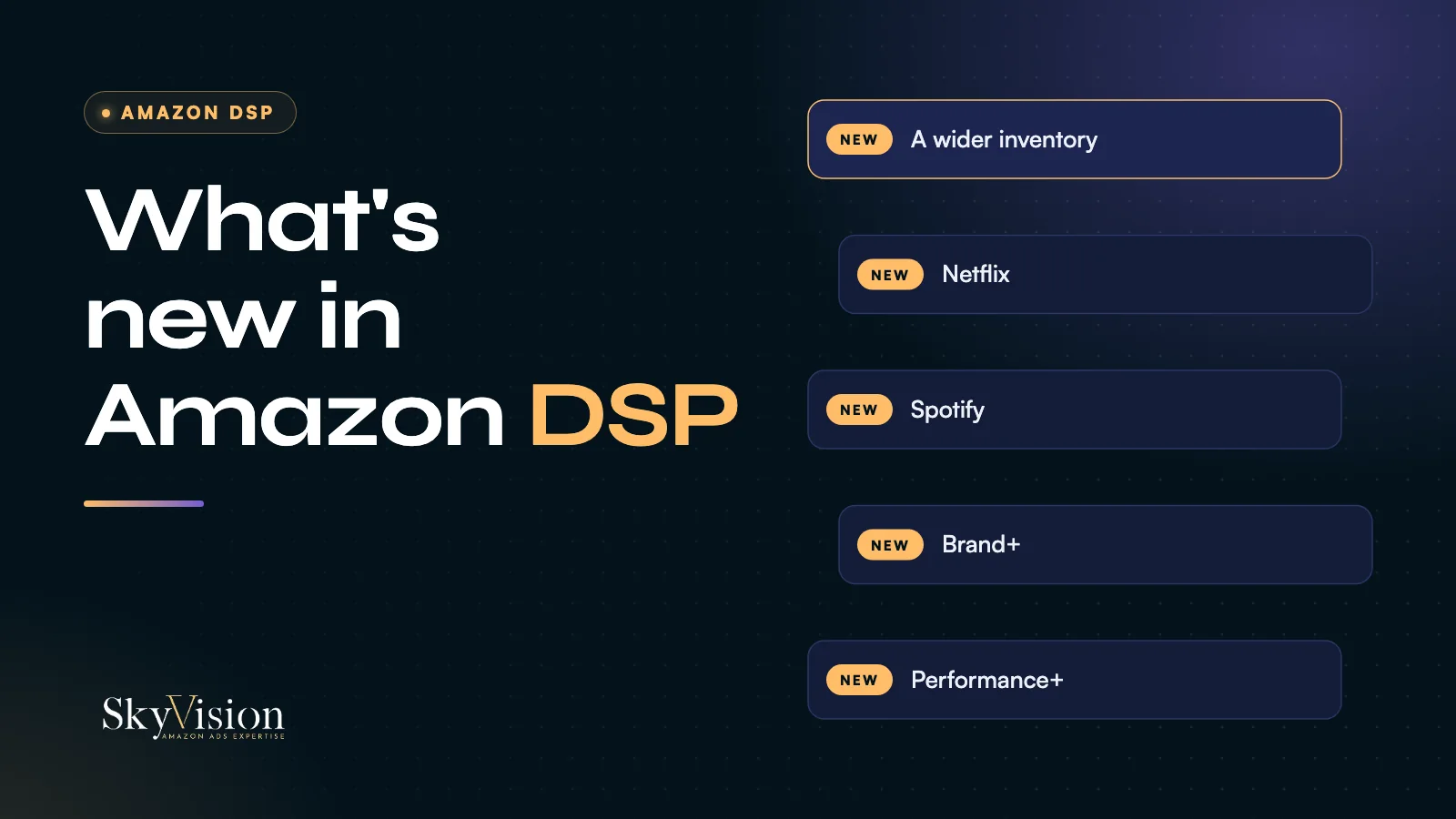
If you still picture Amazon DSP as a banner shown on Amazon, that picture is out of date: the inventory has widened, and two formats driven by automation have arrived.
SKYVISION is an agency specialised in Amazon advertising, so our view is biased. Quentin, co-founder of SKYVISION, takes stock of what has changed in recent months, and of what has not, in this video (5 minutes, in French):
Sponsored Ads or DSP: the difference
With Sponsored Ads, Amazon's classic advertising, the customer does not necessarily look for you. They look for a product close to yours, and you position yourself in front of them so they buy yours. With Amazon DSP, you do not wait for them to come: you go and find them where they are. That is how Quentin frames the difference.
DSP stands for Demand-Side Platform: a platform for buying advertising space, on Amazon and elsewhere.
First change: a much wider inventory
The inventory is where your ads appear. For a long time, according to Quentin, the DSP was the "big brother of display": display on Amazon, with slightly finer targeting.
Today the inventory covers Prime Video, Twitch, Fire TV, plus third-party sites and apps. Amazon has also announced access to Netflix from the fourth quarter of 2025, and to Spotify since 1 October 2025, in markets including the US, the UK and France.
Quentin sorts the formats into three families:
- display, the historical one, on the web and on Amazon;
- Streaming TV, meaning video, which has changed the most in recent months, notably with the arrival of Netflix;
- audio, which is growing fast, notably with Spotify.
One example from the video: for an audio ad, you can choose where to run it, and target Spotify in particular. A brand can therefore reach its audience in ways other than a banner.
Second change: Brand+ and Performance+
The second change is about automation. Two formats have arrived, one for the top of the funnel and one for the bottom. In March 2025, Amazon announced Performance+ as generally available and Brand+ in open beta.
- Brand+ aims at the top of the funnel. Amazon describes it as a way to build brand awareness over time. Quentin adds that it maximises the reach objective: the algorithm decides where and to whom you appear.
- Performance+ aims at the bottom of the funnel. Amazon talks about immediate conversions, measured in cost per acquisition or ROAS. Quentin describes it as geared towards the people most likely to buy.
Quentin's advice: use these formats, but do not let them run the way Amazon suggests. Refine them around your brand and your typical customer, because nobody knows them better than you.
He adds an observation about Performance+: left to itself, it mostly targets the Amazon universe. The idea is to push it to work elsewhere. Amazon, for its part, says in its March 2025 announcement that the optimisation covers both Amazon and third-party inventory, and that inventory selection can be customised.
That leaves the middle of the funnel. At the time of the video, Quentin says, no automated format covers it: it stays manual tuning, even if throttling Brand+ a little gets you close. He also warns that Brand+ could change in the coming months. To place these stages of the buying journey, see our article on awareness, consideration and conversion.
What has not changed: history and product
When a DSP account starts, Quentin explains, there are 30 to 45 days of history to collect. On our side, first results can show from the first month; full ramp-up usually takes 4 to 12 months depending on the account.
Another constant: the DSP does not fix a problem. If your product does not appeal, it will not appeal any more through DSP. Quentin describes it as an accelerator of what already works.
Should you move to DSP before Sponsored Ads?
No, says Quentin: the DSP does not replace Sponsored Ads. If you sell your products on Amazon, do not start with the DSP. It may eventually become the line where you invest the most, but as long as your Sponsored Ads are not saturated, keep going with them and look at the DSP afterwards.
Quentin does not put a number on what "saturated" means. Our article on the Amazon Ads ceiling gives four signals to check.
If you have no physical product to sell on Amazon and only use the DSP, the question does not arise, he adds. That case is covered in Amazon DSP without selling on Amazon.
Frequently asked questions
Is Amazon DSP just banner advertising?
No. Quentin distinguishes three families of formats: display, Streaming TV (video) and audio. The inventory covers Prime Video, Twitch, Fire TV, third-party sites and apps; Amazon has also announced Netflix (from the fourth quarter of 2025) and Spotify (since 1 October 2025).
Should you let Brand+ and Performance+ decide on their own?
Quentin advises using them but refining them yourself around the brand and its typical customer. For Performance+, he also recommends steering it beyond the Amazon universe.
Does the DSP replace Sponsored Ads?
No. If you sell on Amazon, Quentin recommends carrying on with Sponsored Ads as long as they are not saturated, then looking at the DSP.
To see whether Amazon DSP has a place in your plan, read our Amazon DSP page, the complete Amazon DSP 2026 guide and our article on the Amazon DSP minimum budget.


