


Will Amazon cannibalise your e-commerce website?
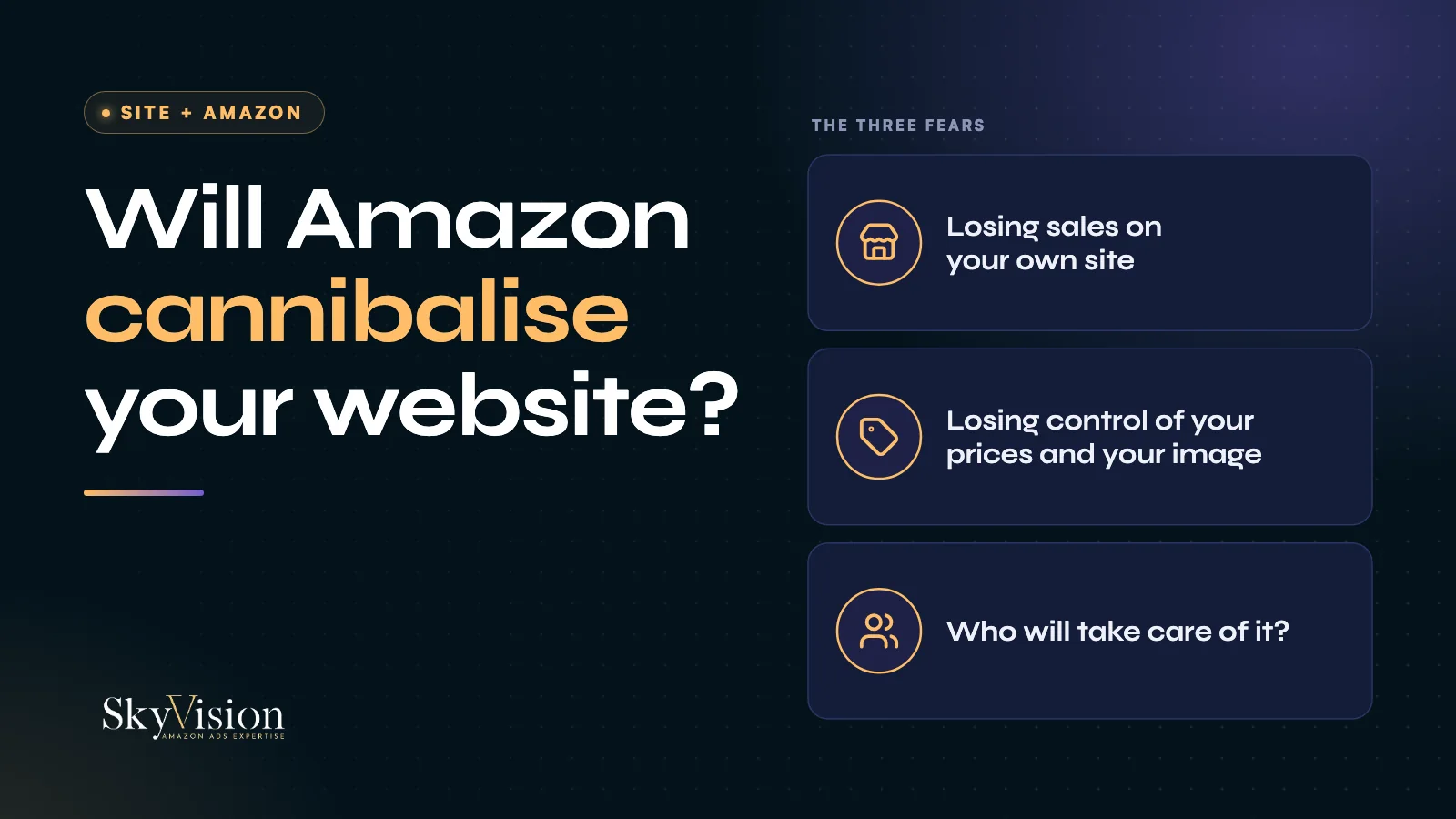
Your website sells very well. One day, someone mentions Amazon, and your first thought is: "If I go on Amazon, I'll cannibalise my site."
That fear of cannibalisation is understandable, and you can check it. SKYVISION is an agency specialising in Amazon advertising, so our view is biased. Erwan, co-founder of SKYVISION, goes through the three fears of brands that sell well on their own site, with a test and a checklist, in this video (8 minutes):
Your brand name may already be on Amazon
Your website is your shop, and Amazon is the big avenue next door. On that avenue, there may already be a shop window with your name on it, set up by someone else: your products at a price you didn't choose, and another brand's poster pasted over your name.
It's an image, but you can check it in 30 seconds. Open Amazon, type your brand the way a customer who already knows you would, and look. Who comes up first? Who sells your products, and at what price? What is displayed around them, with the "Sponsored" label?
We did this on 21 October 2026, on three brands well known in France (amazon.fr, no account, delivery to Paris). On two of the three, the big banner at the top of the page belonged to another brand. For one of them, there was no product from the brand on the first page. Results vary by user and from one day to the next.
To run this check on your brand, we offer a tool, "Is your brand sold on Amazon without you?", which for now works in French and on amazon.fr only. You enter your brand, a search in your category and your work email, and the report arrives after 1 to 3 minutes of scanning (within 24 working hours if an expert reviews it): how many products carry your name, at what price, who sells them, and who pays to appear on your name.
This test shows one thing only: who holds the door today. It doesn't say whether that is authorised (those sellers may be your distributors) or whether it is profitable.
Will Amazon cannibalise your site?
It can, for part of your sales. Some of your regular customers may buy on Amazon instead of buying from you: that sale simply moves to another till. Others didn't know you and discover you on Amazon. To see which group weighs more for you, judge on the total, site plus Amazon, compared with the same period last year. Every brand is different: check your own numbers.
The fear of cannibalisation sees only one of these two customers. The first knows your street by heart, but one day buys on the avenue: that's the sale you fear losing. The second doesn't know your street. They look on the avenue for a product like yours, see your door and walk in. The first exists, possibly for you too. The second is the one the fear forgets.
What we see with our clients: when a brand arrives on Amazon, its website doesn't necessarily change. The customer who is used to Amazon buys there, even if they first found the brand on its site. In the other direction, Amazon can make the site known: with Amazon DSP, your ads also appear outside Amazon, and an ad can send people to your site (see advertising outside Amazon with Amazon Ads).
Two tills, one set of books
You judge on the total, your site plus Amazon, and after a few months you compare it with the same period last year.
- The total went up: the second door brought people in.
- The total didn't move: Amazon mostly shifted sales, with a commission on each one. There, the fear was right.
How long before you judge? First results can show from the first month; full ramp-up usually takes 4 to 12 months depending on the account.
On the avenue, part of the rent is paid on every sale. According to Amazon's page for sellers (viewed on 27 October 2026), most selling fees are between 8 and 15%, depending on the category, and Fulfilment by Amazon logistics come on top. An extra sale isn't always an extra euro of margin. To widen the measurement to the whole brand, see the halo effect.
Losing control of your prices and your image
On the avenue, the walls belong to someone else and your window neighbours may be your competitors. That's partly true, but it first depends on a choice.
A brand can be a seller: it sells itself, sets its prices and keeps its stock until the sale. Or a vendor, through the Amazon Vendor programme, which works by invitation: it sells its products wholesale to Amazon, which becomes the owner of the stock. In that case, according to Amazon France's page on selling online (viewed on 27 October 2026), Amazon generally controls the selling price. Erwan adds that this can be a roadblock, especially as promotions approach. We cover advertising as a vendor in Amazon Vendor advertising.
Staying away doesn't protect your image: it leaves it to others. To protect your name without opening a door, there is Amazon Brand Registry, like having your shop sign registered with the owner of the avenue. According to Amazon (page viewed on 27 October 2026), there are two conditions: a registered trademark, or one with an application pending, and your brand name, or a logo that includes it, permanently affixed to the products or packaging. Enrolment costs nothing, it is possible without selling on Amazon, and it gives you tools to report a suspected infringement of your intellectual property.
Brand Registry doesn't cover everything. A reseller who sells your genuine products, bought from you or from a distributor, generally has the right to do so: European trademark law allows the resale of a genuine product placed on the market in the European Economic Area with the owner's consent, unless the owner has a legitimate reason to object. That's settled with your distributor, not with Amazon.
Who will take care of it?
It's eight in the evening, the shop is closed, you are still doing the accounts, and someone mentions a second door. If nobody has the time, "not now" is a good answer.
Your decisions stay with you. The counter means the advertising and the weekly follow-up, and that can be delegated, in-house or to a partner (see in-house or agency for Amazon Ads). We are an independent agency, we work on your behalf and not for Amazon, and since June 2023 we have managed more than €6M in ad spend, cumulatively. Our rule: we propose, you decide.
Delegating doesn't mean never stopping by the shop: keep a regular meeting, always with the same question. What has changed on the total, site and Amazon together?
Your checklist before opening the door
Before advertising, sort out the basics: stock, margin, photos, reviews. Then, this week:
- Type your brand on Amazon France, and note who comes up, who sells, and at what price.
- Write down your current sales, channel by channel, and, for your three best products, what you would keep from an Amazon sale after fees.
- Write down a first name: the person who will run the counter. A first name, not a job title. If you don't have one, it's not the time yet.
And if you resell other brands without having your own, Amazon Ads isn't your priority.
On Saturday morning, your street will still be there, and Amazon can become one more door, on two conditions: knowing who holds it, and counting what comes in through both. Start with our tool. To look at your brand together, Erwan suggests a 30-minute call, with no commitment.
Frequently asked questions
How can I tell if Amazon is cannibalising my site?
Compare the total, site plus Amazon, with the same period last year, after a few months. Up: the second door brought people in. Flat: Amazon mostly shifted sales, with a commission on top.
Does Amazon Brand Registry remove resellers of my products?
No. It's there to report a suspected infringement of your rights. A reseller of genuine products generally has the right to sell them, and that is settled with your distributor. Also worth reading: Amazon or Shopify: how to choose and Amazon DSP without selling on Amazon.


