


Amazon or Shopify: how to choose in 2026
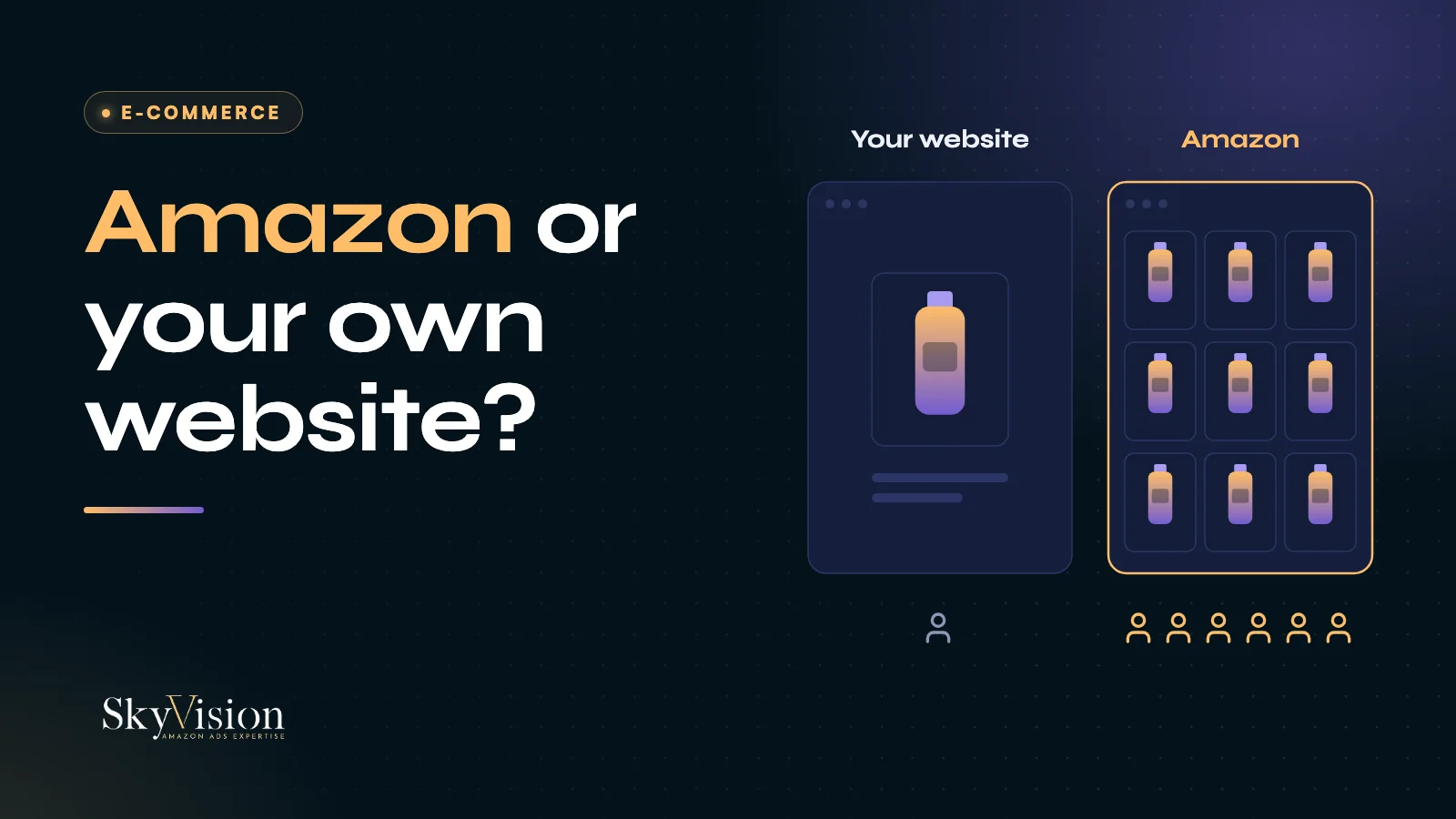
Amazon or Shopify? The question keeps coming back, and it is often framed the wrong way. The right choice does not depend on the platform: it depends on your situation, your margins and your ability to bring people in.
One disclosure before going further: SKYVISION is an agency specialised in Amazon advertising, so our view is biased. Here is the framework we use to decide anyway, without telling ourselves stories. Erwan, co-founder of SKYVISION, walks through it in this video (10 minutes 30, in French with English subtitles):
The difference that decides everything
Amazon is a river that is already flowing: the buyers are there, and they type "best", "cheap", "comparison". They want to buy. Shopify is a well you have to dig: nobody types the name of your brand, so you have to create the desire before people even realise they need the product.
On Amazon, you fight for a place in a market that is already alive, with a decent offer. That does not make it easy: the problem is different. On Shopify, you win by mastering the promise, the creative, trust and repetition. The goal is not one sale, it is a first purchase and then a repurchase.
The classic trap for a Shopify beginner: two weeks choosing a theme, a few days on the logo, and zero visitors at the end. They mistook having a shop for having a shop that sells.
What each model costs
On Amazon.fr, according to Amazon's pricing page (read on 21 October 2026), the Professional plan costs €39 excl. VAT per month, the Individual plan €0.99 excl. VAT per item sold, and most referral fees sit between 8 and 15%, depending on the category. On top of that come logistics (for example Fulfilment by Amazon) and advertising. The fatal mistake: looking at revenue and believing you are profitable without looking at what is left. On Amazon, you have to be obsessed with net margin per unit.
On Shopify, the main cost is not the platform, it is getting people through the door. There is the subscription, payment fees, apps if you pile up too many, then logistics, returns, support and fraud. But you do not die from an average site: you die from acquisition that does not hold up. A paid click, paid retargeting, an abandoned basket to recover, and a margin that melts. Shopify demands one skill: buying traffic and making it profitable.
Who owns the customer?
This is the question that changes everything for customer value over time. On Shopify, a sale does not end at the order: you capture the email, sometimes the phone number, and you can follow up. Abandoned basket, post-purchase, cross-sell, repurchase at 30 days. Every customer becomes an asset you can monetise several times.
On Amazon, it is closer to a department store: you get volume, but the store keeps part of the relationship. Amazon regulates communication with its buyers and does not like sellers steering them to another site: check the rules for your marketplace in Seller Central. The brand is therefore built mostly inside: product listing, A+ Content, Brand Story, Store, ads and Amazon retargeting. In short: Amazon gives you customers, Shopify gives you customers and their contact details.
Three profiles, three answers
Three questions to place yourself. Can you generate profitable traffic today? Does your product get repurchased, or is it a one-off purchase? Does your margin leave you room to breathe once advertising is paid?
- Profile A: beginner, small budget, needs cash quickly. Amazon first. You get a ground where people already search, and you use it as a market test and as a sales engine. One condition: the product must survive net margin, otherwise you sell at a loss.
- Profile B: you can bring people in (creative, creator content, advertising, SEO, influence). Shopify becomes your main weapon: email, SMS, repurchase, bundles. A site like this is a customer lifetime value machine.
- Profile C: ambitious brand with a serious plan. Both, in the right order. Shopify to build the brand base, the customer base and the data. Then Amazon to capture existing demand and take volume: you scale what wins and cut what loses money.
Seven questions to decide
Grab a piece of paper. If you get stuck on two answers, that is already a signal.
- After all expenses, how much is left per sale (price minus product, logistics, returns, fees, payment, advertising)? If you cannot work it out in 30 seconds, you are in danger.
- What is your real average basket? The lower it is, the harder Shopify acquisition gets. The higher it is, the more Amazon makes you justify the value.
- Do your customers buy again within 30 to 90 days? If so, Shopify becomes very powerful. If not, Amazon is simpler at the start.
- Do you sell a search product or a brand product? For a product people already type into the search bar (a charger, a shampoo), Amazon is favoured. For a product driven by desire, aesthetics and identity, it is Shopify.
- Can you generate profitable traffic today? If so, Shopify first is possible. If not, Shopify punishes you and Amazon helps you.
- Which dependence do you prefer: that of a platform (Amazon) or that of an acquisition system (Meta, Google, TikTok)? It is a real question and the answer is not simple.
- Can you handle logistics, returns and support? If not, Amazon's logistics really simplifies operations. If so, Shopify with a logistics provider can scale very well, but quality is up to you.
If you cannot answer the first (net margin) and the fifth (acquisition), do not debate: you are not facing a platform choice, you are facing a business upgrade.
Our view
The wrong choice is not Amazon or Shopify. The wrong choice is picking a platform before you have a model that holds. Amazon, if you want to capture existing demand. Shopify, if you can build an audience and monetise a base. And the hybrid plan, if you want the most robust one.
Erwan personally leans towards Amazon first: many consumers prefer buying on Amazon rather than on a little-known site, because Amazon has earned their trust over time, on refunds as well as on fast delivery. That is an opinion, not a rule: the framework above comes first.
Frequently asked questions
Amazon or Shopify to get started?
When you need to validate a product quickly on a small budget, Amazon is often the more rational choice: people already search there. On one condition, that net margin holds. To validate your customers' interest without stock or a seller account, see the market test with Amazon DSP.
Can you sell on both Amazon and Shopify?
Yes. It is even the most robust plan for an ambitious brand: Shopify to build the brand and the customer base, Amazon for volume. If TikTok Shop tempts you as well, see our Amazon or TikTok Shop comparison. If you worry that Amazon will take customers away from your site, we answer that in our article on Amazon cannibalising your website.
How much does selling on Amazon.fr cost?
According to Amazon's pricing page, €39 excl. VAT per month for the Professional plan or €0.99 excl. VAT per item for the Individual plan, plus referral fees that most often sit between 8 and 15%. Logistics and advertising come on top.
For the advertising side on Amazon, see our Sponsored Products page and the article Sponsored Products, Brands or Display: which to choose. To compare in-house and agency, read in-house or agency for Amazon Ads.


