


Amazon's purchase data: four audience types to activate with Amazon DSP
A running brand targets people who searched for "women's running shoes" or who follow running accounts. Amazon has a different signal: what those people compared, added to their basket and actually bought.
SKYVISION is an agency specialised in Amazon advertising, so our view is biased. Quentin, co-founder of SKYVISION, explains in this video (7 minutes 43, in French) what this purchase data is for and how to activate it, on Amazon and beyond:
What each platform sees
When someone types "women's running shoes", Google sees the search. Meta sees interests: the running accounts or videos the person follows, the ads they clicked. These signals are useful, and they are not the same as Amazon's.
According to Quentin, Amazon sees the shopping journey. Which models the person compared, in which price range, for which use (road or trail). What they added to the basket without buying. And what they have bought over recent months, even recent years. An audience built on that does not gather the merely curious, but people who bought or added to their basket.
The four audience types in the video
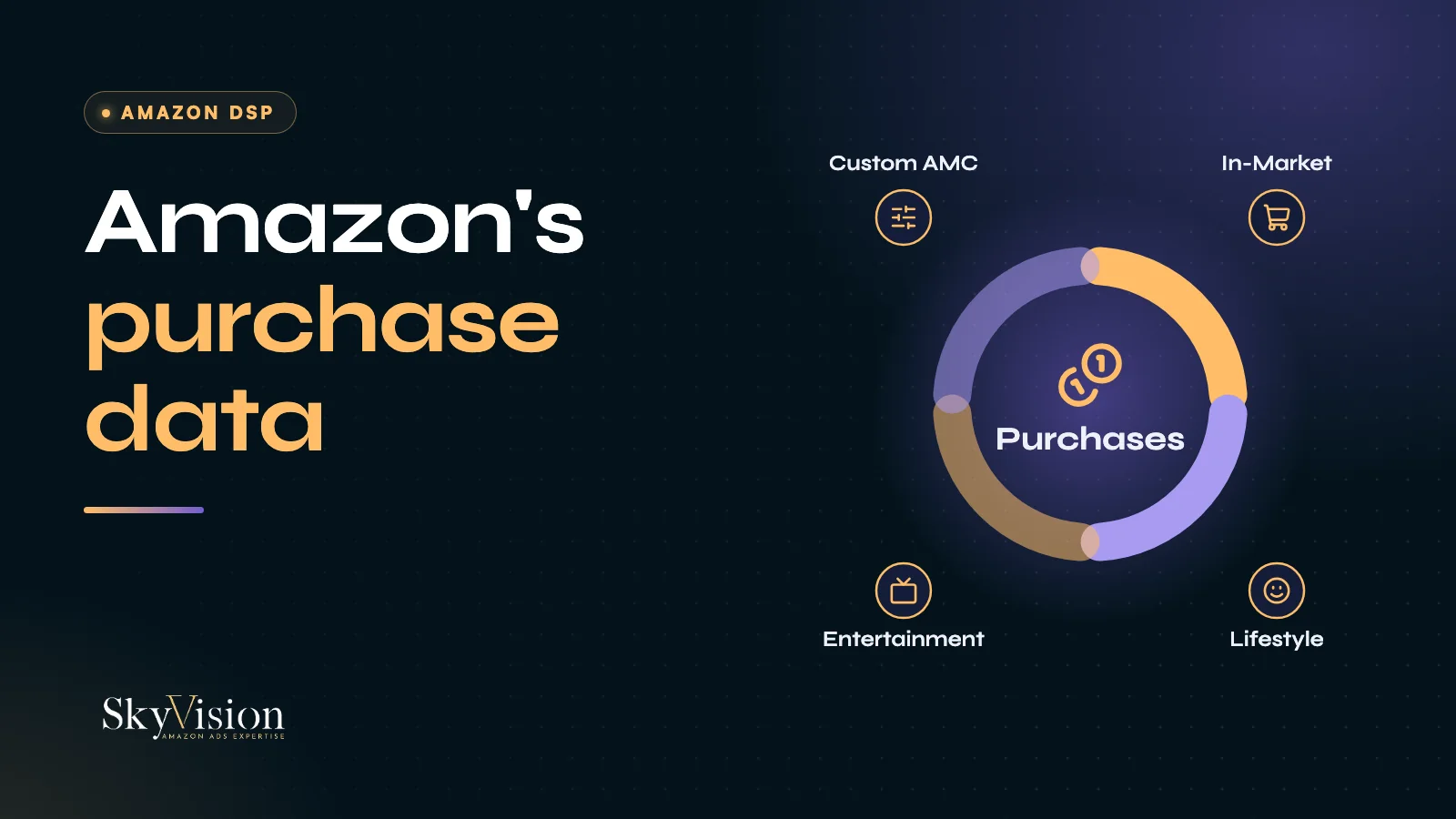
Quentin distinguishes four audience types that can be retargeted on Amazon or through Amazon DSP:
- In-Market: people browsing Amazon's store and comparing before they buy.
- Lifestyle: Amazon spots a way of life, for example "runner", from the equipment bought over one or two years.
- Entertainment: what people watch, such as sports documentaries on Prime Video or Twitch channels about running.
- Custom, through Amazon Marketing Cloud: the audience the advertiser builds itself.
A word on the names. Amazon Ads' page about display advertising lists four predefined audience categories: in-market, lifestyle, interests and life events. They are built from shopping, streaming and entertainment signals. The labels therefore do not overlap exactly with the video's: check the list offered in your own account.
In-Market: what people browse and buy on Amazon
It is built on what people browse and buy on Amazon. Quentin draws three uses from it, which we take in the order of the video:
- Reach people who looked at competing models, or yours, without buying.
- Exclude people who have just bought a pair. They will not buy another one straight away, so there is no point showing them your ads.
- Re-engage people who bought a year or two ago and not since: it may be time to change shoes.
These people can be retargeted on Amazon if your product is sold there, and outside Amazon on the DSP's partner sites and apps.
Lifestyle and Entertainment: moving up the funnel
With Lifestyle, Amazon identifies, for example, a runner. If your product is for runners, you target that audience. If it is for all athletes (a sports watch, sports nutrition), you "move up the funnel" and target athletes in general.
Entertainment follows the same logic, with viewing signals: people who watch sports documentaries on Prime Video, or Twitch channels about sport, running or the marathon. Quentin says so himself: the example is running, but it applies to every field.
Custom: building your own audience with AMC
This is the last step, the most precise and the most complicated. Here Amazon does not build the audience for you: you define it, in Amazon Marketing Cloud (AMC). The video's example: target people Amazon has identified as runners, who bought shoes in a price range close to yours, but last year rather than in recent months.
AMC also lets you ask Amazon a question instead of guessing: how many times a person has to see your ad before buying. In some expensive categories, the delay can be long. You then set the frequency of your audience accordingly.
Amazon presents AMC as a secure, privacy-friendly environment where your data is combined with anonymised Amazon Ads signals, and whose audiences can be activated for media buying. What that means depends on your account and your country: see our Amazon Marketing Cloud page and our article on what you can get out of AMC. It takes time to set up, Quentin stresses.
Where these audiences can run
Amazon DSP inventory includes Prime Video, Twitch, Fire TV, as well as third-party sites and apps. Amazon has also announced access to Netflix from the fourth quarter of 2025, and to Spotify since 1 October 2025, France included.
Selling on Amazon is not a prerequisite: Amazon Ads' page on display advertising says that businesses that do not sell on Amazon can use it to reach and engage audiences. We cover that case in our article Amazon DSP without selling on Amazon.
The limits to know about
Quentin is blunt: this data has a significant drawback. Amazon's customers remain Amazon's customers. You target and retarget these people, but they are not your customers: you get neither their first name, nor their email, nor their address, nor their phone number. Working on them afterwards with other targeting systems, Meta for example, becomes very complicated.
Second limit: the set-up is technical, and Quentin admits it is not for everyone. Supporting this kind of set-up is part of our job, so our view on this point is biased.
Frequently asked questions
Which audience should you pick for a product aimed at all athletes?
According to Quentin, Lifestyle: instead of targeting only runners, you move up the funnel and target athletes in general, for example for a sports watch or sports nutrition.
Can you get the contact details of the people you target?
No. The people you target remain Amazon's customers: you get neither their first name, nor their email, nor their address, nor their phone number.
What is the difference between an In-Market and a Custom audience?
An In-Market audience is built by Amazon. A Custom audience is built by you in Amazon Marketing Cloud: it is more precise, but takes longer to set up.
To see which audience suits your brand, look at our Amazon DSP page, read the complete Amazon DSP guide 2026 and our article on Amazon DSP funnel metrics.


