.webp)

.svg)
Why increasing your Amazon Ads budget no longer grows your revenue
Why increasing your Amazon Ads budget no longer grows your revenue
Every Amazon search term has a finite monthly search volume. What your budget buys is a share of that volume, and the price of that share is not linear. Your first advertising euro and your last do not buy the same thing. The first buys volume. The last buys the right to outbid someone who wanted the same impression you did.
This is not a badly run account
Worth clearing out of the way first, because it is the hypothesis everyone examines.
There are execution reasons a return on ad spend stalls: a confused campaign structure, neglected negative targeting, bids set by instinct, listings that were never audited. If that is your situation, those are fixable inside the account.
What follows describes the opposite. A clean account, campaigns running properly, an agency genuinely optimising, and revenue that stops moving when budget goes up. That moment is uncomfortable precisely because nobody can point to what is wrong.
Why does more Amazon Ads budget stop buying more volume?
When somebody types a search term on Amazon, there is a number of searches per month for that term. That number is what it is. It does not respond to your decision to increase budget by 30%.
Obvious written down. Much less obvious in a monthly review where the question is how do we accelerate, and the most available answer is spend more.
What you buy is a share of that finite volume. It is called impression share, and Amazon defines it in its search term impression share report.
Why that share does not cost the same from start to finish
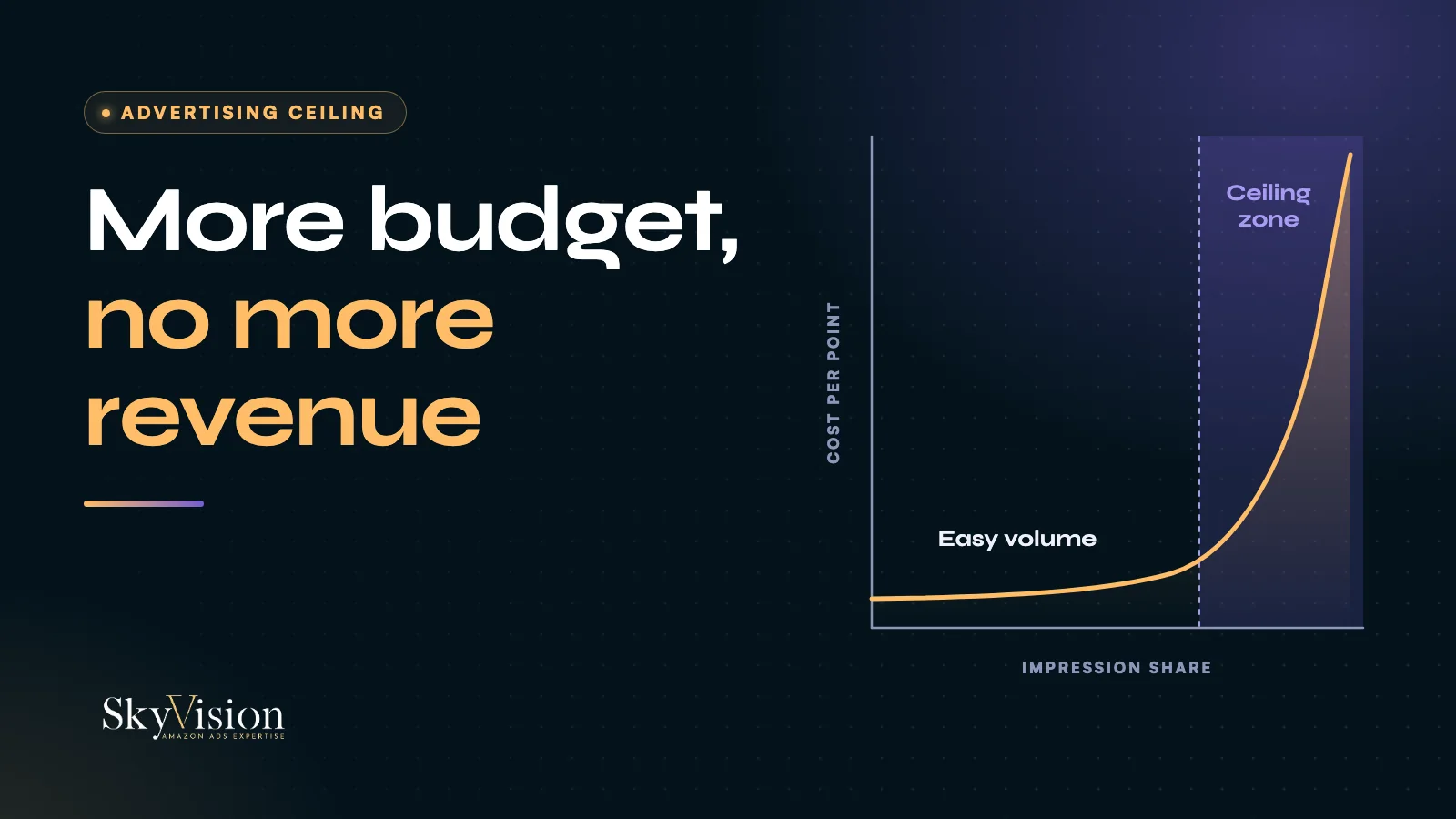
Going from 0 to 40% impression share is easy. You pick up the auctions nobody is really fighting over. Cost per point gained is low.
Going from 70 to 85% is a different story. Every remaining impression is wanted by somebody else. And not just anybody: the advertiser with the best margin, the best conversion rate, or simply the biggest budget. To take an impression from them you have to pay more than they will.
The curve of cost per point of impression share is flat at the start and very steep at the end. That is the ceiling.
Your advertising has not stopped working. It works fine. What happened is that the cost of the incremental volume overtook what that volume returns.
The reflex that makes it worse
When performance stalls, the reflex is to raise bids. Increase budget, launch new campaigns on the same keywords.
Which means paying even more for the part of the market that is already the most expensive. Pressing harder on exactly what is stuck.
There is one exception worth knowing. Impression price varies by hour of day. You are not fighting the same battle at 9am and at 10pm. It is one of the few places where affordable volume remains once the rest of the term is saturated, and it is what justifies granular dayparting rather than a blanket bid increase.
How do you tell whether your account is at the ceiling?
Four indicators answer the question, and you can check them in your console in about twenty minutes.
Top-of-search impression share on your ten main search terms. Average CPC against advertising revenue over six months. Percentage of new-to-brand orders. And total advertising cost of sales set against ACOS.
The detail of each, with reading thresholds, is in our article on the four signals of an Amazon advertising ceiling. Two in the red at once and the diagnosis changes nature.
What it looks like on a chart
The pattern is easy to recognise once you have plotted it. Take twelve months of Sponsored Ads budget and put it on one axis. It climbs steadily, month after month, because the account keeps investing.
Now overlay total revenue. It climbs too, for a while. Then, at some point, it flattens. Budget keeps rising, revenue does not.
The area between the two curves after that point is the money spent for no additional revenue. On the accounts we take over, that number is usually the thing that ends the debate, because it converts an abstract argument about auctions into a figure the finance side recognises.
Worth adding: those accounts are usually not badly managed. Campaigns are clean, negatives are in place, bids are sensible. That is exactly the point. You can be very good at optimisation and still hit the ceiling, because the ceiling is not an optimisation problem.
Is the advertising ceiling an optimisation problem?
It is not a fault. It is not a punishment either, nor evidence that someone did a bad job.
It is an arithmetic consequence of how auctions work. It reaches every account that grows, and it arrives sooner the better you are. A high-performing account captures its impression share faster than others, so it enters the zone where every extra point costs a lot sooner.
Which also means you do not solve it by optimising harder. Optimising an account at its ceiling is repainting a load-bearing wall that is cracking. It looks better, it does not hold better.
The only logical way out
Take the problem from the top, because the answer sits in the statement. You are trying to buy more people in a market where there are not many people left to buy. As long as you stay on Amazon search terms, you are capped by the number of people already looking for your product.
Sponsored Ads do not create demand. They harvest it. They position you in front of people who have already decided to buy in your category and are choosing between you and a competitor. Excellent lever, but capped by construction.
To get past that limit you need a lever that acts before the search. Something that reaches people who are not looking for you yet and brings them to look. On Amazon, that is what DSP does.
It is not one more channel to stack into the mix. It is the way out of the ceiling. Your account still has to be ready for it, and often it is not: the conditions to meet and the cases where waiting is better are covered in our article on Amazon DSP minimum budget.
Frequently asked questions
How long should you wait after a budget increase before concluding?
On existing search campaigns, a few weeks is enough to see whether the extra volume arrives. If revenue has not moved after a month while spend clearly has, the problem is not timing.
Should you cut budget when you are at the ceiling?
Not necessarily. Current budget is producing revenue. What produces nothing is the marginal budget added to the same search terms. The decision concerns the next euro, not the ones already working.
Does the ceiling affect small accounts too?
It mainly affects accounts that have taken a large share of their main search terms. A modest account in a broad category is usually far from it. A modest account in a narrow niche can hit it very quickly.
We will tell you whether you are at the ceiling, or not
We look at your impression share, your CPC trend, your new-to-brand share and your TACoS. If you are not at the ceiling we say so, and you still have affordable volume to collect where you already are. It is the diagnosis we reach most often as an Amazon Ads agency. Ask for the audit. It costs nothing and commits you to nothing.


