.webp)

.svg)
Five signs your Amazon Ads agency is not delivering
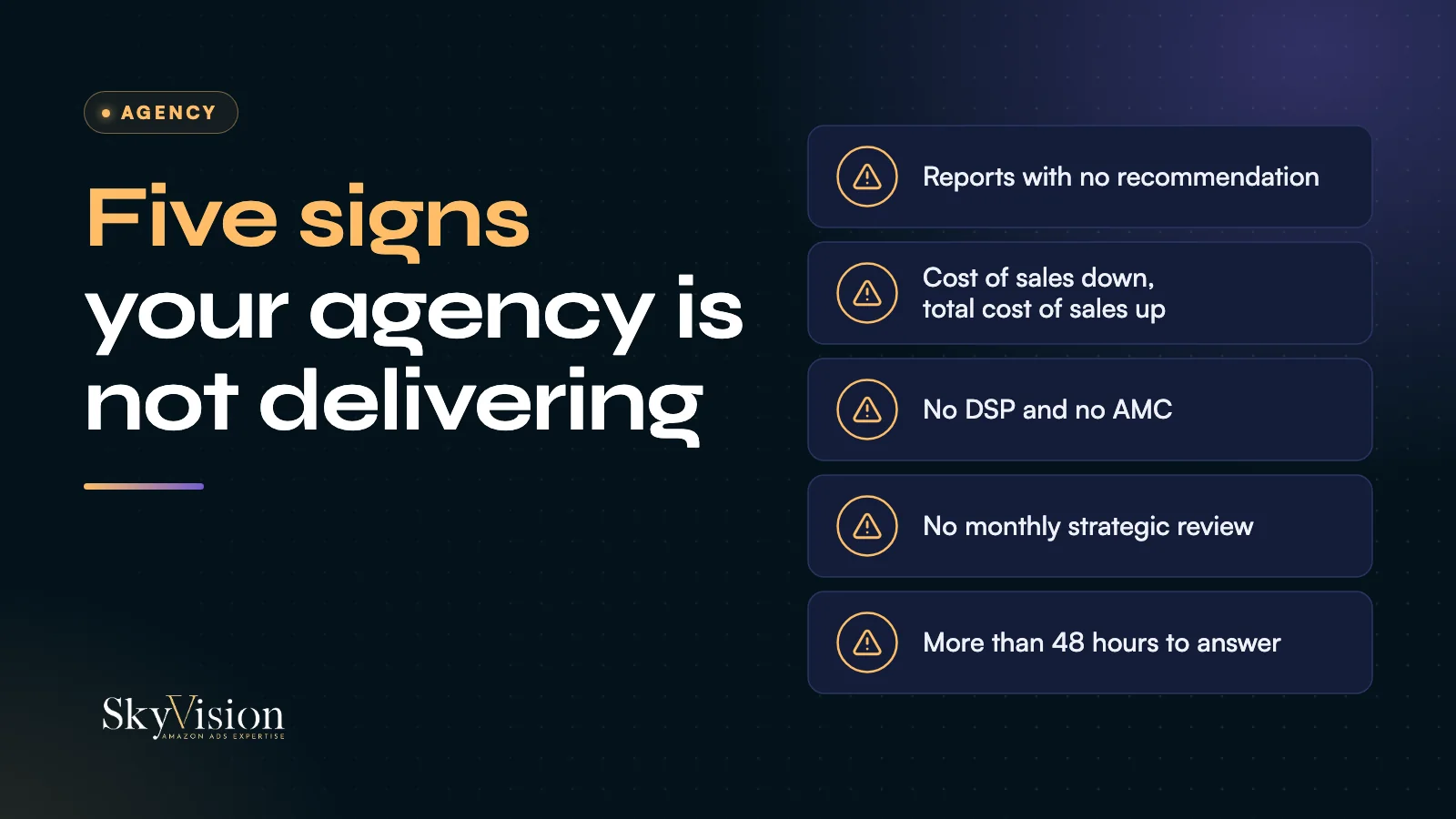
Five signs your Amazon Ads agency is not delivering
You signed with an Amazon Ads agency six or twelve months ago. Your return on ad spend is flat, your total cost of sales is climbing, and your contact sends you reports you cannot really read. Should you be worried? Often, yes. Here are the five signs that an agency is not delivering the value it invoices, and how to move on cleanly if you need to.
This article is for B2B brands that want to assess their current agency rationally, without gratuitous accusation and without hype. Based on accounts audited by SkyVision, an Amazon Ads verified partner, it describes the recurring patterns of underperforming agencies in 2026.
Sign 1. Reports with no actionable recommendation
The symptom: every week or every month you receive a spreadsheet or a document with twenty charts. Return by campaign, cost of sales by keyword, spend by marketplace. Not one sentence saying "we are cutting this", "we are scaling that", "we are testing this format". Just raw data.
Why it matters: a report with no recommendation is a report that creates no value. You are paying for data you could pull yourself from the Amazon Ads console in thirty minutes. An agency's real value sits in the decision, not in the collection.
The quick test: ask your agency what their three decisions are for this month. If the answer is vague, or if they point you back at the report without interpreting it, that is a weak signal.
Sign 2. Cost of sales falling while total cost of sales rises
The symptom: your agency proudly shows you a Sponsored Products cost of sales dropping from 35 to 22 per cent. But your TACoS, total advertising cost against total Amazon revenue, has gone from 12 to 18 per cent. Nobody explained that to you.
One case to rule out first: the same gap can come from a structural limit on the account rather than from the agency's work. The four signals of an advertising ceiling tell the two apart.
Why it matters: cost of sales and total cost of sales tell two different stories. The first falling while the second rises means you are gaining paid revenue and losing organic revenue. That is cannibalisation, not performance. Your brand is consuming its own organic sales to manufacture paid ones.
The quick test: ask for the total cost of sales curve over twelve months. If it rises while cost of sales falls, your agency is cherry-picking the flattering metric and ignoring the other. See our Amazon Marketing Cloud offer to quantify that cannibalisation.
Sign 3. No DSP and no AMC anywhere in the stack
The symptom: your account runs on Sponsored Products and Sponsored Brands only. No advanced Sponsored Display, no DSP, no Amazon Marketing Cloud. When you ask why, the answer is that your budget is too small, or that you do not need it for your objectives.
Why it matters: from around 5,000 euros a month of spend, Amazon DSP becomes relevant: cross-domain retargeting, Streaming TV, advanced audiences. From around 10,000 euros a month, Amazon Marketing Cloud unlocks the incrementality measurement you cannot do without. A serious Partner agency proposes those levers proactively, not reactively once you ask.
The quick test: ask how many DSP accounts they currently manage, and how many AMC analyses they have delivered this quarter. If the answer is none, or "we do not really do that", they do not have the premium stack.
Sign 4. No monthly strategic review
The symptom: you might have a quarterly review. Or none at all. No structured rhythm for discussing strategy, checking progress against annual objectives, launching tests or arbitrating budget across the funnel.
Why it matters: Amazon Ads changes every week. Without a monthly review at minimum, your strategy drifts on assumptions that are out of date. Serious agencies run a 45 to 60 minute strategic review every month with an agenda: performance against objectives, points of concern, new Amazon Ads capabilities worth activating, and the plan for the coming month.
The quick test: look back through six months of your calendar. How many formal strategic reviews with your agency? Below four or five, you are paying for execution without steering.
Sign 5. More than 48 hours to answer a critical question
The symptom: you email your agency on a Monday morning with something urgent, a stockout to anticipate, a sudden drop in return, a campaign to validate before Q4. The answer comes three or four days later, sometimes more.
Why it matters: on Amazon, 48 hours is long enough to burn several thousand euros of badly allocated budget. An agency that does not commit to a fast response on critical matters is losing money on your behalf. Serious agencies contract a response time of six to twelve hours on critical subjects; at SkyVision the average is six hours.
The quick test: send an operational question at two o'clock on a Tuesday afternoon. Note the real response time. More than 24 hours without even an acknowledgement is a very weak signal.
How to check your situation objectively
Beyond the five signs, here are three concrete ways to audit your current agency without guesswork.
An independent audit by a competing agency
Ask a different Amazon Ads partner agency for a free audit of your account. Not to sign with them immediately, but to get an outside read on what your current agency could improve. An honest audit says your agency does X correctly but misses Y and Z. See our free audit.
Comparison against category benchmarks
What is the average return in your category on Amazon? What total cost of sales counts as healthy? What new-to-brand share does a mature account reach? Without a benchmark, your agency can present a return of 3.5 as a success when the category runs at 6.
Reading Amazon's native reports yourself
Log into your Amazon Advertising console in read-only mode, which is your right as the advertiser. Look at the Search Term Reports, the Bulk Operations, the display reports (formerly Sponsored Display). If what you see does not match what your agency reports, ask the question.
How to migrate to a new agency without breaking anything
If you decide to change agency, this process minimises risk and protects your performance.
Step 1. Notice and knowledge transfer (4 weeks)
Give your current agency at least four weeks' notice. Ask for a full handover: campaign structure, DSP audiences, bid rule automations, creative templates, archived AMC analyses, historical files. A serious agency contracts that point from the start.
Step 2. Onboarding the new agency (4 weeks, in parallel)
The incoming agency audits your account in read-only mode while the outgoing one keeps steering. Audit delivered within two weeks, a 90-day action plan within four. You get a clear view of the gap and of the plan before you switch.
Step 3. The switch itself (1 week)
Amazon Ads access transfers to the new agency. The previous one keeps read-only access for two weeks to answer transition questions. Pause aggressive optimisation for two weeks to let things settle.
Step 4. Optimisation sprint (months 1 to 3)
The new agency executes the quick wins in the action plan: negative targeting, campaign structure, product listing audit. First measurable results within four to eight weeks.
Frequently asked questions
Does one of these signs mean I have to leave?
No. A single sign can have an explanation: a temporary team change, a busy period. Three or more at once points to something structural. Talk to your agency openly first: set out the signs, ask for an improvement plan within 30 days. If nothing moves, switch.
How do I avoid falling into the same trap with the next agency?
Ask the five filtering questions: how many accounts in your vertical, what mix of Sponsored Products, Brands, Display, DSP and AMC, which metrics beyond return on ad spend, how they audit product listings, and their average client tenure. Our Partner agency guide has the detail.
How long before a new agency shows an improvement?
First meaningful optimisations at four to six weeks, through negative targeting and campaign structure. Structural results at four to six months. If nothing has moved at eight weeks, the new agency is reproducing the same patterns as the old one.
Can the outgoing agency sabotage my account during the switch?
Rare, but possible. Precautions: change your Amazon Advertising passwords as soon as you switch, remove the previous agency's user permissions, and export a full archive of every campaign before the transition. An agency that contracts the handover properly does not sabotage, but zero trust beats regret.
How do I exit without a financial penalty?
Check your contract. Notice periods on B2B service contracts typically run between 30 and 90 days. No serious agency charges an exit penalty beyond the notice period. If yours tries, that is a sixth sign.
The last word
Auditing your Amazon Ads agency is not an act of aggression. It is normal discipline in any B2B commercial relationship. The five signs described here (reports with no recommendation, cherry-picked metrics, no DSP or AMC in the stack, no monthly strategic review, slow response on critical questions) are concrete and verifiable.
If you see three or more of them, the diagnosis is clear: you are paying for basic execution without strategic value. An Amazon Ads verified partner agency brings a complete technical stack, the discipline of a monthly review and a fast response commitment. See our approach.
SkyVision offers a free independent audit of your Amazon Ads account, delivered within about a week, with a live walkthrough. You leave with a clear map of what your current agency does well, does badly, or does not do at all. Book the free audit.


